Introduction
"Your price is FOB Ningbo — is that OK?" Almost every fabric quotation from a Chinese mill ends with a three-letter abbreviation, and the term you agree on decides who pays the trucking, who clears export customs, at which exact point damage to the goods becomes your problem, and which party can choose the ocean carrier. Get it wrong and a $3.00-per-meter poplin can quietly become a $3.60-per-meter poplin before it reaches your cutting table.
The Incoterms® rules published by the International Chamber of Commerce (the current in-force version is Incoterms 2020, with Incoterms 2025 now being adopted in new contracts) are a standardized vocabulary of eleven three-letter terms. This guide focuses on the five that appear in almost every woven-fabric quotation — EXW, FOB, CFR, CIF and DDP — with special attention to the quirks of shipping textiles by the roll, bale and container from China's main fabric gateways (Shanghai and Ningbo, with Shenzhen/Yantian and Qingdao common for southern and northern mills).
It is written for brand owners, sourcing managers and import beginners buying cotton poplin, corduroy, canvas, twill, linen-cotton blends, quilted and printed fabrics in roll form. We also cover fabric-specific pricing units (meter, yard, kilogram, roll), port charges, the bill of lading, and import clearance basics.
1. What Incoterms Actually Do — and What They Don't
Incoterms answer four questions between buyer and seller:
- Delivery — where and when the seller fulfills its obligation to hand over the goods.
- Risk transfer — at which point loss or damage moves from the seller to the buyer.
- Cost allocation — who pays packing, inland transport, export clearance, ocean freight, insurance, import duties and destination delivery.
- Documents — who must arrange transport documents, customs declarations and proof of delivery.
They do not define ownership/title transfer, payment terms, breach remedies, product specifications or force majeure — those belong in your sales contract and proforma invoice. Always write the exact version on the contract, for example "FOB Ningbo, Incoterms 2020", because the same abbreviation had slightly different obligations in older editions. Also name the precise port or place: "FOB China" is ambiguous in a country with dozens of ports.
2. The Five Terms You Will See on Fabric Quotes
EXW — Ex Works (named place, e.g. EXW Keqiao Factory)
The seller makes the fabric available at its premises. The buyer bears everything from that moment: loading (in practice often helped by the factory), trucking, export declaration, ocean freight, insurance, import clearance, duties and on-carriage. EXW is awkward for foreign buyers in China because export customs declaration normally requires a Chinese entity with export rights. Many small mills solve this by routing through a freight forwarder's Chinese agent, but compliance risk and paperwork sit with you. EXW is common for domestic trades and for experienced buyers with a strong China-based forwarder; it is rarely the best choice for a first-time importer.
FOB — Free On Board (named port of shipment, e.g. FOB Ningbo)
The seller delivers the goods on board the vessel nominated by the buyer at the named Chinese port. The seller pays inland transport to the port, port-related export charges, export customs clearance and loading. Risk transfers when the goods pass the ship's rail — under Incoterms 2020, once they are on board the vessel. From that point the buyer controls and pays ocean freight, insurance, destination charges, import clearance, duty and inland delivery. FOB is the default term in Chinese fabric export and the workhorse of this guide.
CFR — Cost and Freight (named port of destination)
Same risk-transfer point as FOB (on board at the Chinese port), but the seller arranges and pays the ocean freight to your destination port. The buyer still buys insurance, clears import customs and pays duty plus destination charges. CFR is also written C&F or CNF in older correspondence. A subtle trap: risk passes in China even though the seller chose the carrier — if damage occurs at sea, you claim on your own insurance while the seller held the transport contract. CFR suits buyers who want one invoice for goods plus freight but are comfortable insuring themselves.
CIF — Cost, Insurance and Freight (named port of destination)
Identical to CFR except the seller must also buy minimum-cover marine cargo insurance (Clause C type, typically 110% of contract value) for the buyer's benefit. CIF is convenient for small, first-time orders, but note the seller's insurance is minimum cover and the policy may be in Chinese with a Chinese insurer — claims handling in your country can be slow. Seasoned importers often prefer FOB plus their own open cargo policy, which gives broader cover (all risks, war and strikes clauses) at competitive premiums.
DDP — Delivered Duty Paid (named place of destination)
The seller carries all costs and risks to your door, including import clearance, duty and VAT/GST. It is the most comfortable term for the buyer and the most dangerous for a Chinese seller, which is why most mills will not quote true DDP — they lack a foreign entity to act as importer of record. Offers labelled "DDP" from trading companies or logistics firms are usually a bundled door-to-door service where the forwarder handles clearance; verify who is named as importer of record and whether VAT is properly invoiced. DDP can make sense for small e-commerce restocks but is generally expensive for full-container fabric volumes.
| Obligation | EXW | FOB | CFR | CIF | DDP |
|---|---|---|---|---|---|
| Export packing | Seller | Seller | Seller | Seller | Seller |
| Truck to Chinese port | Buyer | Seller | Seller | Seller | Seller |
| China export clearance | Buyer | Seller | Seller | Seller | Seller |
| Origin port charges (THC etc.) | Buyer | Seller | Seller | Seller | Seller |
| Ocean freight | Buyer | Buyer | Seller | Seller | Seller |
| Marine insurance | Buyer | Buyer | Buyer | Seller (min.) | Seller |
| Risk transfers… | At factory | On board, China port | On board, China port | On board, China port | At buyer's door |
| Destination port charges | Buyer | Buyer | Buyer | Buyer | Seller |
| Import clearance & duty/VAT | Buyer | Buyer | Buyer | Buyer | Seller |
| Truck to your warehouse | Buyer | Buyer | Buyer | Buyer | Seller |
Two related terms worth knowing: FCA (Free Carrier) is the modern, container-friendly cousin of FOB — delivery and risk transfer happen when the seller hands goods to your nominated carrier at a named place (often the carrier's container yard or CFS warehouse), which better reflects how containerized cargo actually moves; and FO/"free out" language in charter shipping is unrelated to Incoterms and should not be confused.
3. Inside FOB: The Step-by-Step Handover
Under a typical FOB Ningbo or FOB Shanghai fabric order, the sequence looks like this:
- Booking — you (or your forwarder) nominate the vessel and issue a booking confirmation with vessel name, voyage, cut-off dates and delivery address for the container.
- Container allocation — for FCL, the empty container is trucked to the mill or to a warehouse for live loading; for LCL, fabric is delivered to the forwarder's CFS (container freight station) for consolidation.
- Export declaration — the mill (or its export agent) files the customs declaration in China with the commercial invoice, packing list and the correct HS code.
- Port formalities — the seller pays terminal handling, documentation, seal and gate-in fees and delivers the loaded container to the terminal before the closing time.
- On board — once loaded on the vessel, risk and the freight bill are yours. The carrier issues the bill of lading.
- Transit — typical sea transit from Shanghai/Ningbo is roughly 25–35 days to the US West Coast, 35–45 days to the US East Coast and 30–40 days to North Europe/Mediterranean, depending on service and transshipment.
- Destination — your forwarder or customs broker files import entry, duty is assessed, cargo is released against the bill of lading and trucked to your warehouse or garment factory.
The "FOB Local Charges" Gray Zone
FOB disputes in the China fabric trade usually concern small invoices, not the freight itself. Before the goods reach port, Chinese forwarders issue a set of local fees known by names such as THC (terminal handling charge), booking fee, documentation fee (B/L fee), telex release fee, seal fee, VGM/weighing fee, AMS/ENS manifest fee (US/EU advance manifest systems) and CFS charges for LCL. Under a clean FOB reading, origin-side charges are the seller's, but some mills quote "FOB excluding local charges" or pass through the nominated forwarder's fees. Agree in writing which origin fees are included in the FOB price, and be aware that a buyer-nominated forwarder may quote you a low ocean rate while charging the Chinese supplier high local fees — the supplier will either resist or quietly recover the money in the next order's unit price.
4. Why FOB Dominates the Fabric Trade
FOB is quoted on the overwhelming majority of Chinese textile proforma invoices for practical reasons on both sides:
- The buyer controls the main carriage. Freight is volatile — a 40'HQ rate to Europe can move by hundreds of dollars between quotation and production. FOB lets the mill quote fabric without guessing freight, and lets you allocate containers across several suppliers to fill one box.
- Consolidation is natural. Brands often buy poplin from one Keqiao mill, corduroy from another and accessories from Yiwu. Under FOB, your forwarder consolidates LCL shipments or books multiple FCL containers under one logistics program.
- Clear risk boundary. "On board the vessel" is a well-understood point; insurance, claims and responsibility stop being a negotiation after damage is discovered.
- Cash flow and compliance. The mill handles the part that requires Chinese export licensing and local paperwork; you handle the part requiring an importer of record in your own country. Each side does what it is licensed and positioned to do.
FOB is less ideal when you are buying a single small LCL shipment and have no forwarder relationship — in that case CIF (or a CFR quote you insure yourself) reduces setup work. Very small buyers sometimes accept a supplier's CIF for the first trial order and switch to FOB once volumes justify a forwarder contract.
5. How Fabric Is Priced and Measured: Meters, Yards, Kilograms and Rolls
Unlike garments, fabric is priced against several units, and the unit itself changes how an order must be inspected. Always state the unit in the contract and reconcile it on the packing list.
| Unit | Common use | Notes for buyers |
|---|---|---|
| Meter (m) | Worldwide default for woven fabric; all China export quotes | 1 m = 1.0936 yards |
| Yard (yd) | US market; some UK/Commonwealth heritage accounts | 1 yd = 0.9144 m; always confirm whether a "yard price" was converted from a meter price |
| Kilogram (kg) | Knit goods, yarn-dyed bulk commodity cloth, some greige goods | Rare for finished woven apparel fabric; moisture regain and sizing add weight, so weight-based deals need conditioning rules |
| Square meter (m²) / GSM math | Cost engineering, comparing weights | Weight per linear meter = GSM × width in meters (e.g. 150 GSM × 1.48 m ≈ 222 g/m) |
| Roll / piece (匹, pǐ) | Packing and counting, not usually pricing | A typical Chinese fabric piece is 50–120 m depending on loom and category; short pieces are sold with declared minimums |
Width, Length and the "Cuttable Width" Trap
Woven apparel fabric is produced in finished widths — 140–150 cm is typical for shirting poplin and printed cloth; 145–155 cm for many canvas/twill items; wider widths up to ~240 cm exist for bedding and quilted goods. Quotations say "width 148 cm," but garment markers run on the cuttable (usable) width, excluding selvedge and any pin-hole margins from stenter frames. A fabric declared at 150 cm with only 146 cm usable changes your consumption calculation by several percent. Specify both finished width and minimum cuttable width with tolerances (a typical finished-width tolerance is ±1–2 cm).
Roll length matters too. Typical export roll lengths are 50–60 m for lighter fabrics and 80–120 m for heavier constructions, but each order should state: minimum roll length, maximum number of short rolls, maximum pieces (cuts) per roll, and whether joining/stitched pieces are allowed. A common term is "one piece per roll, 60 m ± 5 m, no joined pieces," or tolerance language such as "max 10% of rolls may contain 2 pieces, each piece ≥ 20 m."
Packing and Container Loading
Finished woven fabric is normally wound on paper tubes, individually sleeved in poly bags, and shipped either as loose rolls (each roll tagged, stacked or racked) or bales (rolls compressed into woven polypropylene bales, typically 2–8 rolls per bale depending on weight). Heavy canvas and corduroy often travel in double-layer poly bags plus woven outer bags. Quilted fabrics are bulky and are usually rolled without hard compression to protect the batting.
For freight budgeting, ask the mill for the estimated gross/net weight and CBM (volume) per roll or bale. A 40-foot high-cube container offers roughly 68–76 m³ of usable volume and a payload near 26–28 t depending on the shipping line; textile loads usually cube out (fill by volume) before they weigh out, except for dense greige or heavy canvas. Typical figures depend entirely on GSM, width and roll packing — request the computed loading plan rather than relying on rules of thumb. LCL shipments are charged on the greater of actual volume (CBM) or volumetric weight, and fabric almost always bills on CBM.
6. Port Charges and Destination Costs: What a Fabric Importer Actually Pays
A buyer's landed cost under FOB includes the following typical categories. Exact amounts move with freight markets and port policy, so treat these as line items to request, not fixed prices.
| Cost line | Who under FOB | What it is |
|---|---|---|
| Inland trucking mill → port | Seller | Container drayage or LCL delivery to CFS |
| Origin THC, doc, seal, booking, manifest | Seller* | Chinese terminal and forwarder local charges (*confirm inclusion) |
| China export customs declaration | Seller | Filing by the mill or its export agent |
| Ocean freight | Buyer | FCL per-container or LCL per-CBM/ton, BAF/EBS surcharges may apply |
| Marine cargo insurance | Buyer | Typically 0.2–0.5% of insured value for all-risk textile cover, depending on insurer and route |
| Destination port charges | Buyer | DTHC, CFS unpacking (LCL), port security, documentation, ISF/ENS-type filings |
| Customs bond / clearance fee | Buyer | Broker fee; US importers need a continuous or single-entry bond |
| Import duty & taxes | Buyer | Set by HS code, origin and trade preference program |
| Trucking port → your warehouse | Buyer | Drayage plus possible chassis/detention fees |
| Demurrage / detention / storage | At-fault party | Charged if boxes sit at port or are returned late — avoidable with prompt clearance |
Two planning tips. First, ask your forwarder for an "all-in" destination charge sheet in writing before the first shipment; LCL destination fees are notoriously itemized and can exceed the freight itself on tiny shipments. Second, budget for demurrage from day one: free time at major ports is commonly 7–14 days for containers and only a few days for LCL cargo, and clearance delays caused by missing documents get expensive fast.
7. The Bill of Lading and the Document Set
The bill of lading (B/L) is receipt for the cargo, evidence of the contract of carriage and — in its original negotiable form — a document of title. Three forms appear in textile trade:
- Master B/L (MBL): issued by the ocean carrier. Highest authority; consignee fields drive release.
- House B/L (HBL): issued by a freight forwarder/NVOCC; standard when you ship LCL or through a consolidator. Your HBL consignee details are matched against the forwarder's MBL.
- Telex release / express release / Sea Waybill: no paper originals are couriered; the agent at destination releases cargo against proof of identity. Faster and common in trusted repeat relationships. A sea waybill is non-negotiable by design.
A standard fabric document set comprises: commercial invoice (in English, matching the L/C or payment terms), packing list (roll count, length per roll, net/gross weight, CBM per bale, lot and color numbers), bill of lading, and a certificate of origin where preferential duty applies. China-origin goods may qualify for a RCEP certificate of origin among member economies, or a general (non-preferential) C/O; ask your broker which form your country honors. For restricted or regulated markets, expect possible requests for test reports (AZO, formaldehyde, pH), fumigation certificates for wooden packing (most export pallets are ISPM-15 stamped), or fiber-content declarations.
HS Codes: the Duty Lever
Woven cotton fabrics fall mainly under Chapter 52 of the Harmonized System — for example unprinted cotton poplin/twill around headings 5208–5211, with the exact code set by cotton percentage, weight per m² (above or below 200 g/m²), bleached/dyed/yarn-dyed/printed status and blend. Woven pile fabrics such as corduroy sit in heading 5801; synthetic-blend wovens route to Chapter 55; quilting and other quilted piece goods may fall in Chapter 58. Duties differ meaningfully between these headings, and the legal classification is the importer's responsibility. Send the spec sheet to your broker for a written classification before the first shipment — never just copy the code the factory wrote on its invoice, since the exporter's code reflects Chinese export nomenclature, not your destination tariff.
Clearance Basics
You (or your broker) declare the cargo with commercial value, HS code, country of origin and fiber content; pay assessed duty, VAT/GST and any excise; and take release. Typical compliance gates for apparel fabric include fiber-content labeling that meets your market's rules (EU Regulation 1007/2011, the US Textile Fiber Products Identification Act), restricted-substances limits on azo dyes/formaldehyde for certain end uses, and — for children's products in the US — CPSIA traceability and testing when the fabric itself is the retail article. Piece goods imported for further manufacture face fewer labeling rules than finished sewn products, but your cut-and-sew factory still needs the composition data for its garment labels.
8. Fabric-Specific FOB Pitfalls
| Pitfall | Why it hurts | Preventive clause / action |
|---|---|---|
| Short-length and thickness claims | Rolls delivered at 57 m instead of 60 m across 500 rolls is a 5% shortage | Pre-shipment inspection with measured length per roll; tolerance cap (e.g. ±2% per shipment); AQL sampling |
| Water-weight disputes on kg pricing | Moisture regain and size add mass; fabric dries in transit | Prefer meter pricing for finished wovens; if kg, state official regain and test at a conditioned lab |
| Wet or water-damaged rolls on arrival | Container rain, wet pallets; dye migration and mildew | Desiccants, poly wrapping, "keep dry" marks; inspect and photograph at loading; all-risk insurance with sweating/heating clause |
| Color lots split across containers | Garments cut from different vessels shade mismatch | One color lot per container; lot numbers on roll labels and packing list |
| Buyer-nominated forwarder price gouging | High Chinese local charges inflate the mill's real cost | Audit origin local fees; cap them; compare forwarders annually |
| Missing cut-off → rolled to next vessel | 3–10 day delay, possible demurrage on empties | Agree production-ready date one week before CY cut-off; FOB seller bears storage if late without force majeure |
| "FOB factory" wording | Not a real Incoterm; often used informally to mean EXW-like delivery | Always write FOB + named port; never sign "FOB factory" |
9. Choosing the Right Term: A Scenario Map
| Your situation | Suggested term | Reason |
|---|---|---|
| First trial order, LCL, no forwarder yet | CIF (then switch later) | Minimum setup; buy your own insurance if volume allows |
| Recurring FCL program, multiple Chinese suppliers | FOB | Control freight, consolidate, optimize cost |
| Experienced importer with China office/agent | FCA or FOB | Container-yard handover fits real logistics flow |
| Small e-commerce restock, wants zero logistics work | DDP via reputable forwarder | One delivered price; verify importer-of-record and VAT invoicing |
| Buying greige or commodity cloth by weight | FOB, priced per kg with conditioning terms | Specify moisture regain and inspection at loading |
| Sensitive seasonal range, tight retail deadline | FOB + air/LCL fallback plan | Control lets you upgrade mode without renegotiating with the mill |
10. How a Keqiao Mill Typically Quotes Shipping
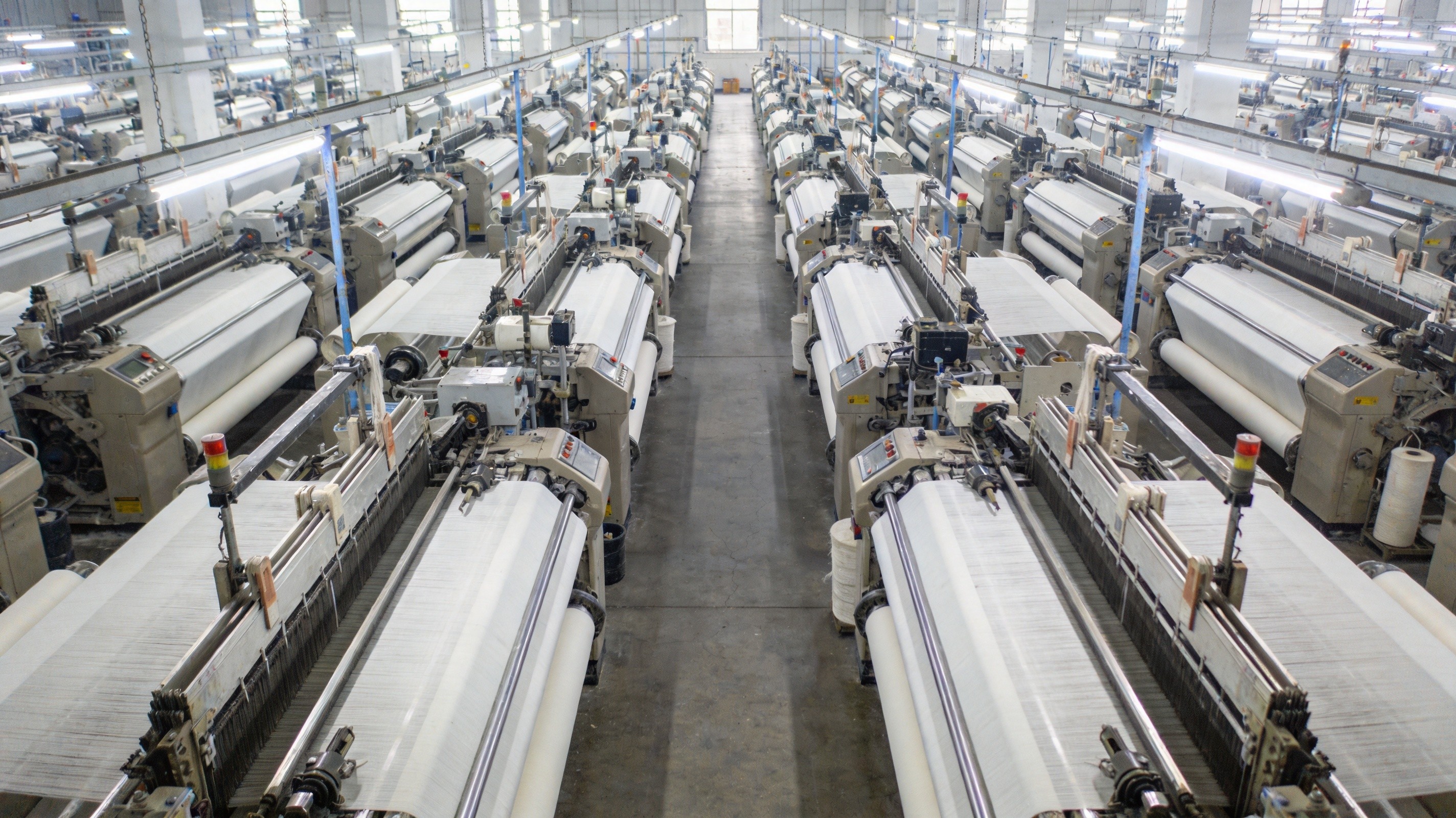
At China Textile City in Keqiao, Shaoxing, most woven-fabric factories — including our own cotton poplin, corduroy, canvas/twill, linen-cotton and digital-print lines — quote FOB Ningbo or FOB Shanghai in US dollars per meter, because Ningbo-Zhoushan is the nearest deep-water port (roughly a 1–2 hour trucking leg) and Shanghai offers the densest global sailing network. MOQs often start around 300 m per color for in-stock qualities, with bespoke qualities at higher minimums. A typical proforma invoice shows unit price per meter, total meters and total FOB value separately, packing details (roll length, tubes, bags, bales), payment terms (typically 30% deposit, 70% against copy of shipping documents for established buyers), and the requested port.
Good Keqiao suppliers will, on request: give you gross/net weight and CBM calculations for your forwarder, accept your nominated forwarder's booking, mark shipping marks and side marks exactly to your artwork, keep one color lot together, and supply the full document set within a few days of sailing. These points are worth confirming at order stage rather than at the warehouse gate — more on operational timelines in our sample-to-bulk sourcing timeline guide, and on commercial conditions in our MOQ and payment terms guide.
FOB Fabric Import Checklist
At quotation:
- [ ] Term written as FOB + exact port + Incoterms version year
- [ ] Pricing unit confirmed (meter/yard/kg), plus width and cuttable width
- [ ] Roll length, piece-per-roll rules and short-roll tolerance agreed
- [ ] Packing method, gross/net weight and CBM per bale requested
Before production/booking:
- [ ] Forwarder nominated; origin local charges disclosed in writing
- [ ] HS code reviewed by your destination broker; duty and taxes modeled into landed cost
- [ ] Cargo insurance arranged (all risks) if buying FOB/CFR
- [ ] Shipping marks and side marks finalized; color-lot separation agreed
After sailing:
- [ ] B/L, invoice, packing list and C/O checked against the PO before release
- [ ] Customs entry filed early (ISF for US within legal window)
- [ ] Drayage booked to beat free-time expiry; inspect cargo on arrival and note exceptions on the POD
Mujia Textile (mujiatextile.com) is a factory-direct cotton and cotton-blend woven fabric supplier based in Zhuji, Zhejiang, next to Keqiao. We quote FOB Ningbo/Shanghai in USD per meter with transparent packing lists, support buyer-nominated forwarders, and provide the full export document set on every shipment. Tell us your destination port and order volume — we will send the FOB price, loading calculation and swatch cards together.