Introduction
A fabric specification sheet — also called a spec sheet, tech sheet, technical data sheet (TDS) or, in Chinese mills, 规格单 (guīgé dān) — is the single document that defines what you are actually buying. Your purchase order says "10,000 m cotton poplin." The spec sheet answers the questions that determine whether that poplin costs $1.20 or $2.40 a meter and whether it sews into a premium shirt or a disposable one: which cotton, spun how fine, woven how densely, finished how, tested to what numbers, rolled and labeled how?
Sourcing problems that end in rejections almost always trace back to a vague or unverified spec: "same as sample" means nothing after a dye lot ages; "good quality" has no legal meaning; and a hand-feel approved on a March sample can drift invisibly across a June bulk. This guide walks through every line a competent woven-fabric specification sheet should contain, gives typical industry ranges for cotton and cotton-blend apparel and home-textile fabrics, and shows you how to check each item, where the traps are, and how to request a properly completed sheet from a Keqiao factory.
1. What a Proper Spec Sheet Looks Like
A professional spec sheet is usually one or two pages and contains five blocks:
- Identification — fabric code/name, buyer style reference, version date, mill contact.
- Construction — composition, yarn counts, density, weave, finished width, weight.
- Color and finishing — color standard, dyeing method, mechanical and chemical finishes.
- Performance — shrinkage, colorfastness grades, strength, pilling, pH/formaldehyde and other chemical limits, with test methods.
- Delivery form — roll length, tube, inner/outer packing, labels and shipping marks, gross/net weight and carton/bale data.
Every numeric field should name its test method and tolerance. A bare "shrinkage 3%" without a standard is unenforceable; "dimensional change to washing ≤ 3% warp / ≤ 3% weft, tested per ISO 6330 / AATCC 135, 3× washes at 40 °C, tumble dry" is enforceable. That distinction is the difference between a spec sheet and marketing copy.
2. Header and Identification Fields
- Article/style number — the mill's permanent construction code (e.g. an internal poplin code) plus your style number. The mill code lets you reorder the identical construction years later; your code ties the fabric to a garment tech pack.
- Date and revision — specs evolve. "Rev. 3, 2026-10-20" prevents bulk from being produced to an old approved sheet.
- End use — stating "men's woven shirts" or "upholstery cushions" lets the mill select appropriate finishing and pre-warn you on tests (upholstery needs abrasion and light-fastness numbers apparel does not).
- Reference standard / sample — approved lab dip number, strike-off or sealed fabric sample. Always reference a physical or digital standard with a date rather than "per buyer sample."
3. Composition (Fiber Content)
The composition line names every fiber and its percentage by mass, for example "100% combed cotton", "55% linen / 45% cotton", "98% cotton / 2% elastane" or "65% polyester / 35% cotton". For blends, percentages are given by weight after standard conditioning, and tolerances in major markets are tight — EU rules allow only small deviations attributable to normal manufacturing variability, and deliberate rounding ("about 80/20") is not legal on a consumer label.
Buyer checks: confirm whether the cotton is carded or combed (combed removes short fibers and neps; shirting poplin is usually combed), whether it is ring-spun, open-end or compact, and whether claims such as "organic," "BCI" or "GRS recycled" come with a transaction certificate. Cheap quotes for "100% cotton" sometimes hide minor polyester content from recycled selvedge waste — a composition test (quantitative chemical analysis per ISO 1833 or AATCC 20A) on the first bulk costs little and settles the question. For a deeper treatment of fiber types and identification, see our fabric composition and fiber content guide.
4. Yarn Count — the Fineness Number
Yarn count describes how fine the warp and weft yarns are, and it drives hand-feel and cost more than almost any other line. Two numbering systems coexist:
- English cotton count (Ne) — indirect: bigger number = finer yarn. Standard for cotton wovens worldwide. A 40s yarn is finer than a 30s.
- Tex / denier (T, D) — direct: bigger number = heavier yarn; used for synthetics and some technical fabrics.
The spec reads like "40s × 40s" (40 Ne warp, 40 Ne weft) or "60s × 60s" for fine shirting. Common woven apparel territory is 30s–60s; fine 80s–100s counts are luxury shirting; 10s–21s are canvas, duck and heavy twill country. A "133×72, 40s×40s" poplin is a classic dense construction; dropping the yarn from 40s to 32s while keeping the same density numbers produces heavier, cheaper-feeling cloth at lower cost — a classic invisible substitution.
Checks and traps: ask whether the count is nominal or actual tested count; blended yarns may be quoted as "equivalent" cotton count; and ply matters — 60s/2 (two-ply 60s) is a very different, stronger yarn than single 60s. If a quoted price seems too good to hold, yarn count and density are the first places to audit.
5. Thread Density (Ends and Picks)
Density is written "133 × 72" — ends per inch (or per cm) in the warp × picks per inch in the weft. Higher density at the same yarn count means more yarn per meter, tighter cloth, crisper hand-feel and a higher price. Poplin is defined structurally by a high warp density over a lighter weft; a typical shirting poplin sits around 110–140 ends and 70–90 picks per inch, while a canvas is a lower-density but very heavy-yarn plain weave.
| Fabric type | Typical yarn count (Ne) | Typical density (E×P per inch) | Typical weight |
|---|---|---|---|
| Light shirting poplin | 60s × 60s / 50s × 50s | ~130–160 × 80–100 | 90–120 GSM |
| Standard print poplin | 40s × 40s | ~120–133 × 70–80 | 110–135 GSM |
| Cotton twill / chino | 32s × 32s / 21s × 16s | ~120–130 × 70–80 | 180–260 GSM |
| Canvas / duck | 10s/2–21s/2 | ~40–60 × 30–45 | 280–450+ GSM |
| Corduroy (warp × weft) | often 32s/2 × 16s/21s pile system | wale count 4.5–21 wales/inch defines type | 180–320 GSM |
| Linen-cotton blend | ~21s–40s equivalents | medium, 80–120 × 60–80 | 130–220 GSM |
Trap: density can be inflated on paper but achieved with thinner yarn — so judge count and density together against GSM. The three numbers must be arithmetically coherent (weight per square meter is a function of yarn mass and thread count). A lab can ravel and count threads per inch on a conditioned specimen in minutes.
6. Weight: GSM and oz/yd²
Fabric weight is expressed in grams per square meter (GSM or g/m²) globally and in ounces per square yard (oz/yd²) in the US. Conversion: 1 oz/yd² ≈ 33.91 GSM; thus 6 oz ≈ 203 GSM. The spec should state finished (not greige) weight and a tolerance, typically ±5% for piece goods.
Weight is the fastest sanity check at receiving: weigh a representative conditioned swatch of known area, or cut a 100 cm² disk with a round cutter and scale ×100. A "130 GSM" poplin arriving at 118 GSM is outside typical tolerance and almost always means yarn, density or width games. Note moisture affects mass — disputes are settled under standard atmosphere (roughly 20 °C, 65% RH) after conditioning, not on the wet warehouse floor. More on choosing weights in our fabric weight and GSM guide.
7. Width — Finished and Cuttable
Width is given finished, edge to edge, in inches or centimeters: 57/58", 148 cm, 150 cm. Apparel wovens commonly run 140–150 cm; wide home-textile widths run 220–240 cm. The spec should also state usable/cuttable width excluding selvedge and stenter pin marks, and a tolerance (±1–2 cm is typical). A garment marker built on 150 cm that only has 145 cm cuttable quietly raises fabric consumption 2–3% — measurable across thousands of meters. Width and GSM together also let you compute weight per linear meter for freight costing.
8. Weave and Construction
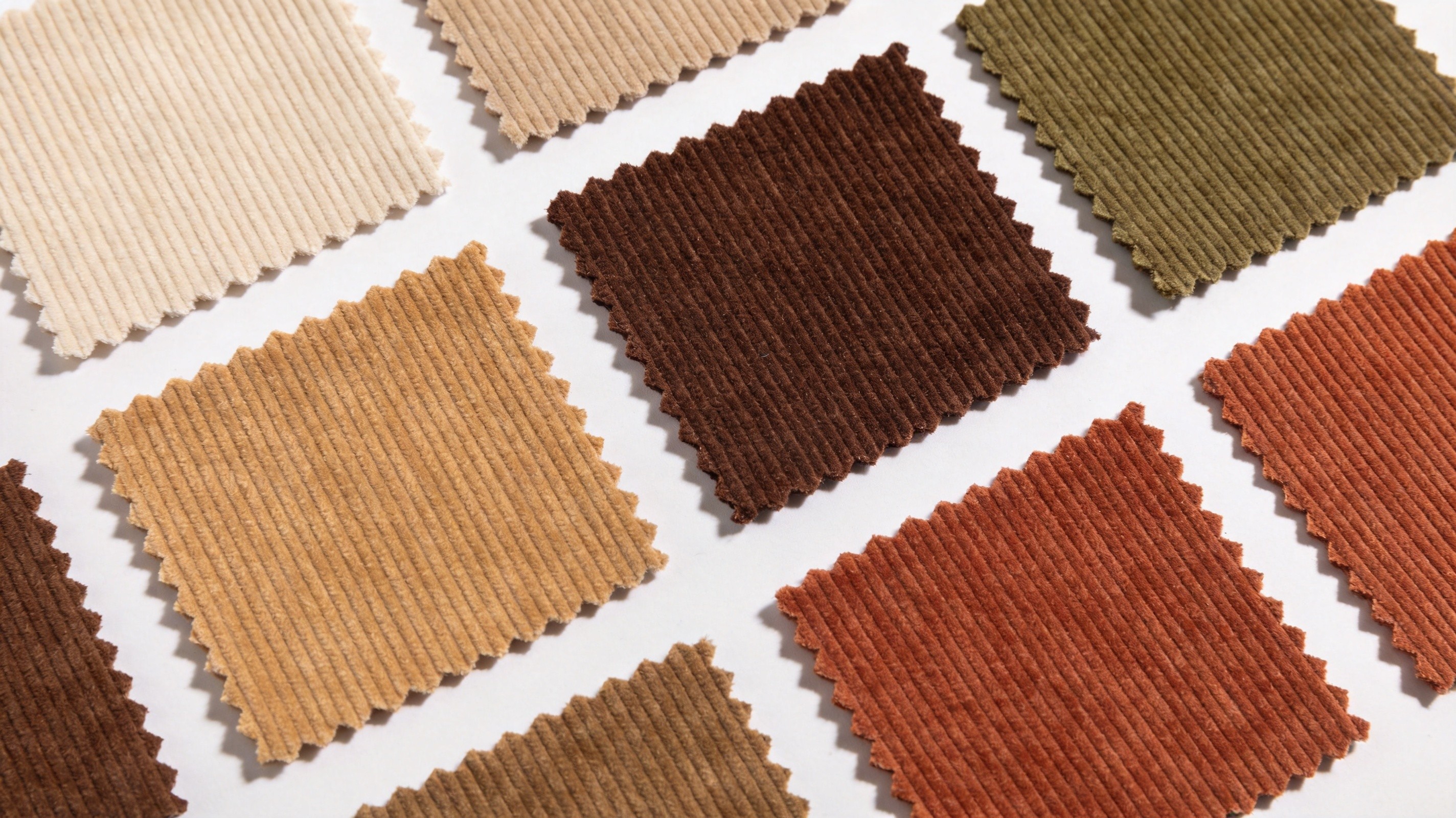
The weave line names the interlacing structure: plain (poplin, canvas, voile), twill (2/1, 3/1 drill, denim, chino), satin/sateen, dobby, jacquard, pile (corduroy, velvet), or specialty constructions such as seersucker, oxford or ripstop. For corduroy, the key number is wale count — ribs per inch (about 4.5–8 wide wale, 11–16 mid, 16–21 fine wale) — plus pile construction and whether it is cut-pile piece-dyed or piece-dyed cotton; see the dedicated corduroy wale and specs guide. For quilted goods, specify face/back cloth, batting fiber and gsm, quilting pattern and stitch density. Small weave details (stripe repeat width, dobby motif size) should be attached as a technical drawing with measurements.
9. Color: Lab Dips, Strike-offs and Tolerance
- Color standard — named Pantone TCX/tpx code, customer physical standard or digital spectral target with light source (D65 daylight, TL84 store light, CWF, A/incandescent, UV).
- Lab dip — the mill's small recipe swatches before bulk; approve in writing per light source and check metamerism (color that matches in daylight but shifts under store light).
- Instrument target — professional approvals use a spectrophotometer with a ΔE ceiling; a ΔE ≤ 1.0 under D65 is a common tight standard, up to ~1.5 acceptable in commercial practice depending on the brand.
- Prints — printed fabrics need a strike-off approval covering color, scale, registration and hand-feel; digital print additionally needs file specs (repeat size, color profile, resolution).
- Lot control — the sheet should commit to lot numbering, shade continuity ("no shade change within one roll; shade bands separated and marked") and lot separation by roll label.
10. Dyeing and Finishing (Wet Processing)
This block describes how greige cloth becomes finished fabric and heavily affects hand-feel, shade stability and compliance.
- Dye method — reactive, vat, sulfur or pigment dyes for cotton; reactive and vat generally give the best wash-fastness on cotton; pigment prints have a characteristic dry hand unless bonded.
- Preparation — singeing, desizing, scouring, bleaching, mercerization. Mercerized cotton accepts dye more evenly, gains luster and strength; shirting lines often specify it.
- Mechanical finishes — sanforizing/compressive shrinkage (pre-shrunk), stentering, peaching, brushing (corduroy), calendering, pre-washing, garment-wash compatibility.
- Chemical finishes — softeners (silicone changes seam slippage behavior), wrinkle-free/resin (formaldehyde-bearing — declare limits), water/oil repellent, anti-microbial, flame retardant, PFAS-free requirements where your market demands them.
- Print route — rotary screen, flat screen or digital (reactive/pigment/acid ink by fiber); digital print minimums and color limits differ completely, as explained in our digital printing guide.
Trap: finishes affect later garment processing. Silicone softener can ruin bonding and print adhesion; resin-treated cloth tests low on formaldehyde only if properly formulated; un-mercerized cotton dyed in deep shades can crock badly. State the intended garment wash (stone wash, enzyme, bleach) up front so the mill tests fastness against that process.
11. Performance and Test Data — the Numbers That Protect You
A credible sheet lists test item, method, requirement and typical result. Methods are from ISO, AATCC/ASTM, GB (Chinese national standards, often ISO-equivalent), or retailer protocols (Marks & Spencer, NEXT, H&M manuals are stricter than generic standards).
| Test | Common method | Typical apparel requirement |
|---|---|---|
| Dimensional change (shrinkage), woven | ISO 6330 / AATCC 135 | ≤ 3% warp & weft after sanforizing; ≤ 5% for relaxed/linen-look goods |
| Colorfastness to washing | ISO 105-C06 / AATCC 61 | ≥ grade 3–4 change, ≥ 3–4 staining |
| Colorfastness to rubbing (crocking) | ISO 105-X12 / AATCC 8 | dry ≥ 4, wet ≥ 3 (deep shades) / 3–4 |
| Colorfastness to light | ISO 105-B02 / AATCC 16 | ≥ 3–4 apparel; ≥ 4–5 home textiles/curtains |
| Colorfastness to perspiration | ISO 105-E04 / AATCC 15 | ≥ 3–4 |
| Tensile / tear strength | ISO 13934 / ASTM D5034, D2261 | by fabric weight; lightweight wovens often ≥ 200–300 N breaking |
| Seam slippage | ISO 13936-2 / ASTM D434 | ≤ 6 mm at specified load for shirting/trousering |
| Pilling | ISO 12945-2 (Martindale) | ≥ 3–4 (blends with polyester pill more) |
| Abrasion (home/textile) | ISO 12947 Martindale | ≥ 15,000–20,000 cycles upholstery; apparel rarely specified |
| pH | ISO 3071 | roughly 4.5–8.5 for apparel (baby wear tighter, ~4.0–7.5) |
| Formaldehyde | ISO 14184-1 | ≤ 75 mg/kg direct-skin apparel under common brand lists; ≤ 20–30 baby goods |
| Azo dyes / aromatic amines | ISO 14362; EU REACH Annex XVII | banned amines ≤ 30 mg/kg each; azo-colorants restricted in EU |
| Skew / torque | after wash measurement | ≤ 3–4% for wovens |
Treat these as typical commercial ranges, not universal law — a baby line, a workwear program and a dry-clean-only curtain each demand different limits. The key habit is requiring the method and number on the sheet, then testing bulk against that same method. Third-party labs (SGS, Intertek, Bureau Veritas, TÜV, QIMA and local labs in Keqiao) run a basic cotton-woven package (composition, GSM, shrinkage, wash/crock fastness, pH, AZO/formaldehyde) at modest cost per specimen.
Four Traps in the Test Block
- Greige results vs finished results — only finished, processed fabric matters.
- Single-wash vs three-wash shrinkage — always state the wash count and drying method; tumble drying moves numbers significantly.
- Grading without the gray-scale standard — "grade 4" means a grade against ISO 105 A02/A03 scales; insist on a lab report.
- Sample from the salesman, not the line — test reports must come from production rolls sampled by an inspector, not mailed show-room fabric.
12. Roll Form, Packing and Labels
The delivery specification is where mills lose money quietly and buyers lose garments quietly. Define all of it:
- Roll/piece length — e.g. "60 m ± 5 m, one continuous piece, no stitched joins"; or permitted short-piece ratio ("max 10% of quantity in rolls of 30–50 m").
- Tubes — inner diameter and material; standard paper tubes, strong enough not to crush; tube tare weight excluded from fabric measurement.
- Wrapping — poly bag per roll, woven PP outer bale, desiccant for humid voyages; vacuum compression avoided for pile and quilted fabrics.
- Bale/carton build — rolls per bale, bale dimensions, net and gross weight, total CBM; this feeds container loading.
- Roll label / 卷标 — article code, color and lot number, roll number, piece length, gross/net; barcode if your warehouse scans.
- Shipping marks / 唛头 — main marks (buyer logo/name, destination, P.O. number, style, color, quantity, carton/bale no., dimensions, gross/net, origin "Made in China") printed per your artwork; side marks for handling ("Keep Dry", no-hook symbols).
Inspection should reconcile roll labels to the packing list and physically measure at least sampled lengths; "long paper, short cloth" (标签长、布面短) is an ancient complaint in piece-goods trade. Request a tolerance cap on total shipped length versus invoiced length — ±1–2% is standard language.
13. Putting the Spec Sheet to Work: Approval Flow
- You issue the spec with your garment tech pack: construction target or reference sample, end use, performance limits, packing, standards to follow. Buyers who cannot write the technical construction can specify an approved counter sample and performance requirements, and ask the mill to complete construction.
- Mill returns the filled TDS with achievable values and tolerances. Negotiate before, not after, sample approval.
- Lab dip / strike-off approved in writing, archived with date and light box.
- Pre-production sample (PP sample / 船头样) made on the actual route, tested to the sheet; seal it. This sample is your bulk benchmark.
- Bulk inspection by AQL (commonly AQL 2.5 major / 4.0 minor on a 4-point system for piece goods — ASTM D5430 is the familiar standard), with rolls measured and random lab tests on line samples. The 4-point system deducts points by defect length; common acceptance ceilings are ≤ 20–40 penalty points per 100 yards depending on the program.
- Final spec sheet copy travels with the shipping documents; retain it for reorders and claims.
For the human side of verifying these numbers on-site — lab equipment, calibration, inspection tables — our China factory audit guide shows exactly what to look at in a Keqiao mill.
14. How to Ask a Keqiao Factory for a Qualified Spec Sheet
A short, specific request filters professional suppliers from traders reciting catalogs. Adapt this message:
"Please quote against and return a signed technical data sheet (English) including: exact composition with fiber percentages; actual tested yarn counts Ne; density ends × picks per inch; finished and cuttable width; finished weight GSM ±%; weave; full finishing route (dye type, mercerized, sanforized, softener/chemical finishes); colorfastness to wash/crock/light/perspiration with ISO or AATCC method and grade; shrinkage after 3 washes with method; pH, formaldehyde and azo test values; roll length rules, tube, inner/outer packing, label content and shipping marks; plus gross/net weight and CBM per bale. Values must be achievable in bulk and will be verified by third-party testing of production rolls. Please also state the tolerance you guarantee on weight, width and length."
A capable Keqiao factory returns this in one or two emails with a clean TDS and test reports; a weak supplier disappears, answers "same as sample," or copies back your numbers without achievable-tolerance comments — itself valuable sourcing intelligence.
Spec Sheet Quick Audit List
- [ ] Header: article + style code, revision date, end use, approved standard/lab dip number
- [ ] Composition: all fibers %, carded/combed, certificate claims attached
- [ ] Yarn count: Ne warp × weft, single/ply, tested not nominal
- [ ] Density: ends × picks per inch, coherent with count and GSM
- [ ] Weight: finished GSM, ±% tolerance, conditioned measurement
- [ ] Width: finished and cuttable, tolerance in cm
- [ ] Weave: structure, wale count or quilt construction as applicable
- [ ] Color: standard code, light sources, ΔE limit, lot separation rules
- [ ] Finishing: dye type, mercerize/sanforize, chemical finishes disclosed
- [ ] Performance: method + requirement + report for shrinkage, fastness, strength, pH/formaldehyde/AZO
- [ ] Delivery: roll length, joins policy, packing build, label and shipping-mark layout
- [ ] Bulk control: AQL/4-point acceptance, third-party test on line samples, signed sheet attached to documents
Mujia Textile (mujiatextile.com) supplies factory-direct cotton poplin, corduroy, canvas/twill, linen-cotton, quilted and digitally printed fabrics from Keqiao, Shaoxing. Every quotation comes with a filled English specification sheet — composition, construction, GSM, width, finishing route, test standards, roll packing and shipping marks — so your tech pack, your lab and your garment factory all work from the same numbers. Send us your target specs or an approved counter sample for a matched, testable quotation.