11 Cutwork Designs · Full-Density & Open-Sparse · 100% Cotton
100–130 GSM · 135 cm · FOB $2.3–2.7/m · MOQ 300 m · Lead within 10 days
Mujia Textile’s broderie anglaise — also called cotton eyelet embroidery (Chinese: 全棉打孔绣 / 镂空绣花布) — is a 100% cotton embroidered cutwork fabric, 100–130 GSM and 135 cm wide, offered in 11 in-stock designs (E-01 to E-11) split into full-density all-over eyelet (E-01, E-03, E-06, E-11) and open/sparse embroidery (E-02, E-04, E-05, E-07, E-08, E-09, E-10). Produced by Shaoxing Mujia Textile Co., Ltd. (est. 2012) in Keqiao, Shaoxing, China, it is priced at FOB US $2.3–2.7 per meter depending on design, packing and quantity, with an MOQ of 300 meters and lead time within 10 days. Payment terms are T/T; L/C at sight for larger orders. Free A4 swatches are available worldwide. OEKO-TEX Standard 100 testing can be arranged on request through certified upstream partners, and quality is governed by Mujia’s proprietary quality inspection system (MTQS).
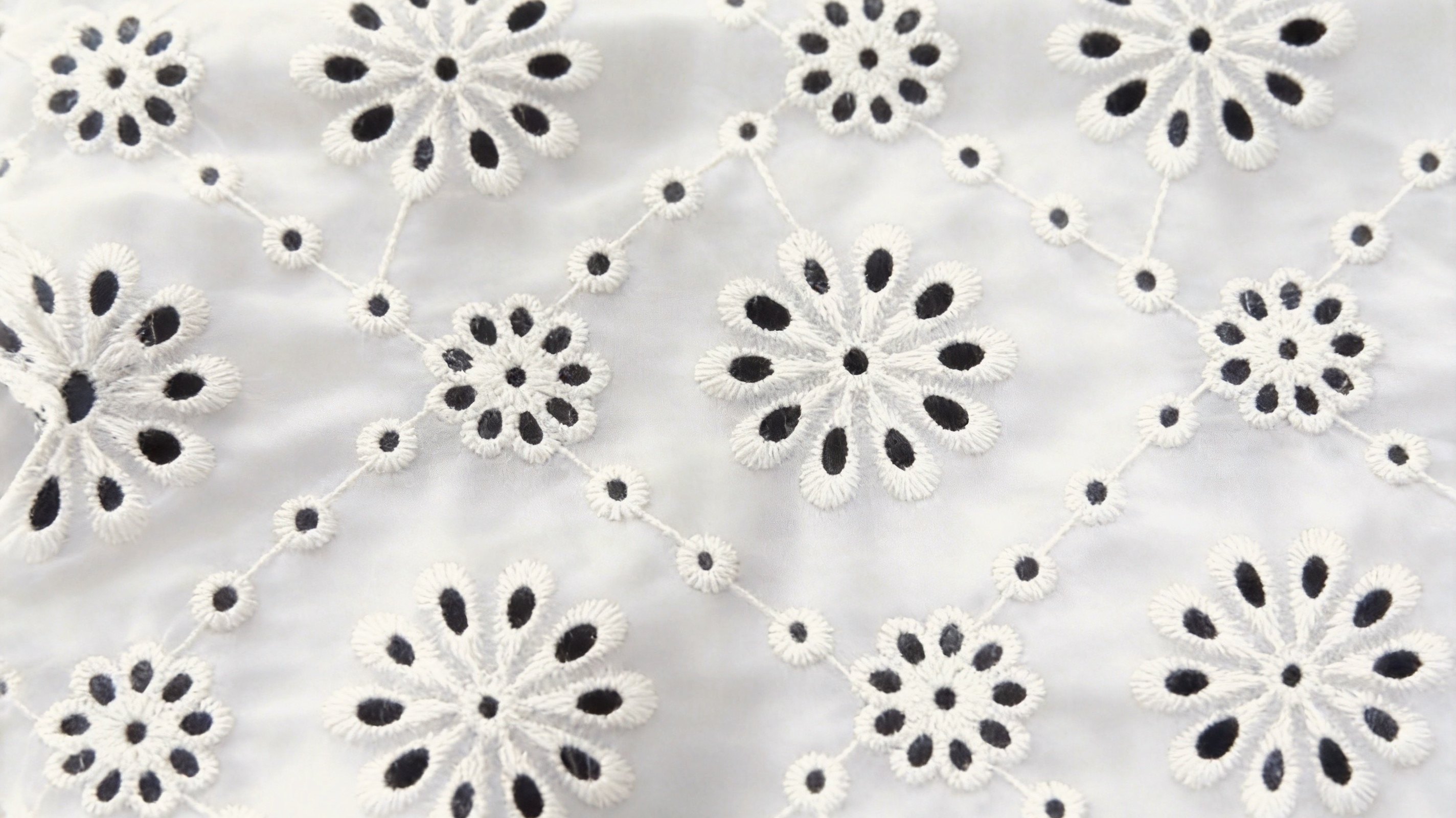
Broderie anglaise is the classic white-on-white cotton embroidery where patterns are outlined in fine stitching and the centers are cut open to form delicate eyelet holes. Our cotton eyelet collection uses a soft, breathable 100% cotton base (100–130 GSM, 135 cm) in a natural off-white shade. The 11 designs fall into two layout groups: full-density all-over eyelet for a rich, romantic look, and open / sparse embroidery for light, airy garments with negative space.
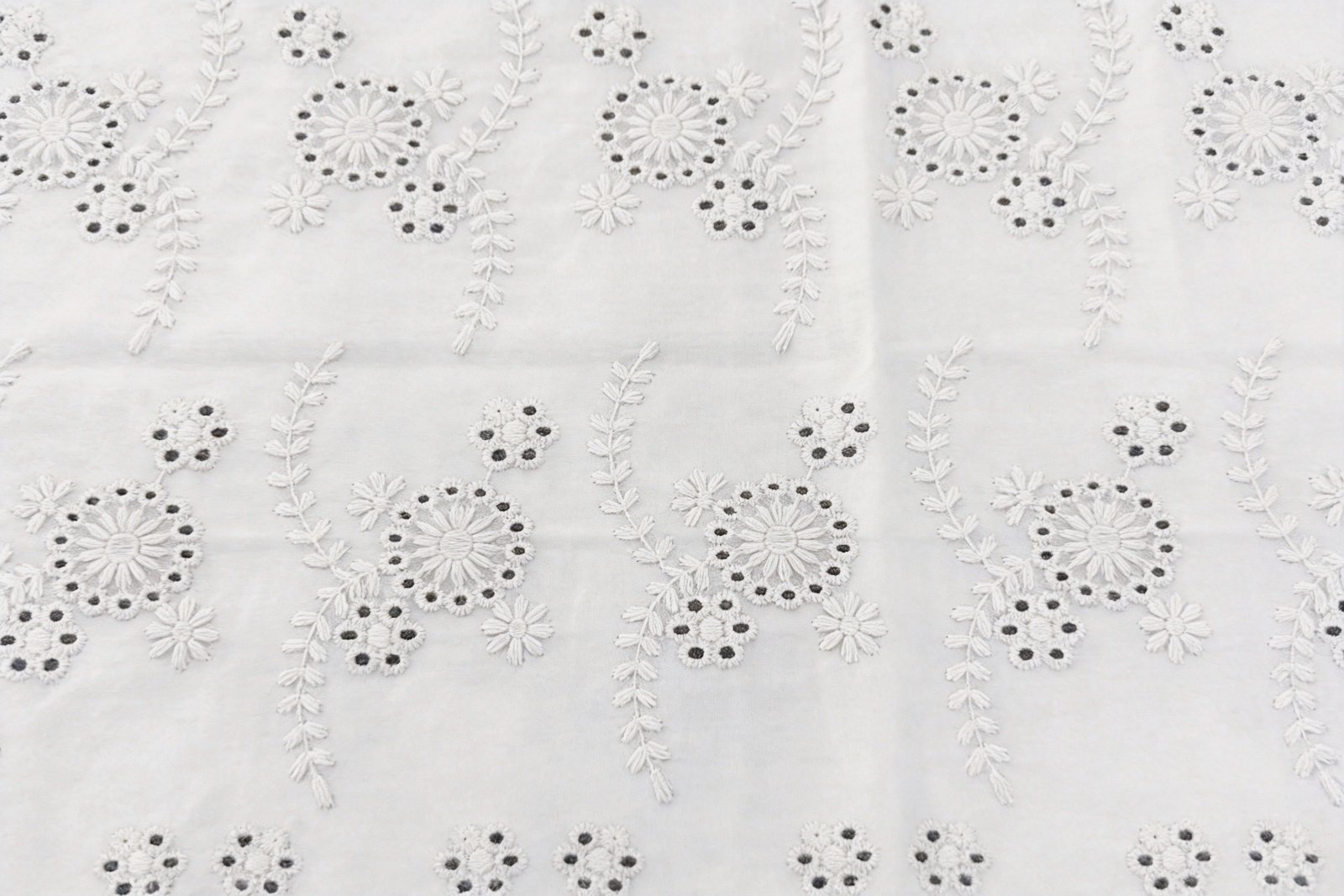
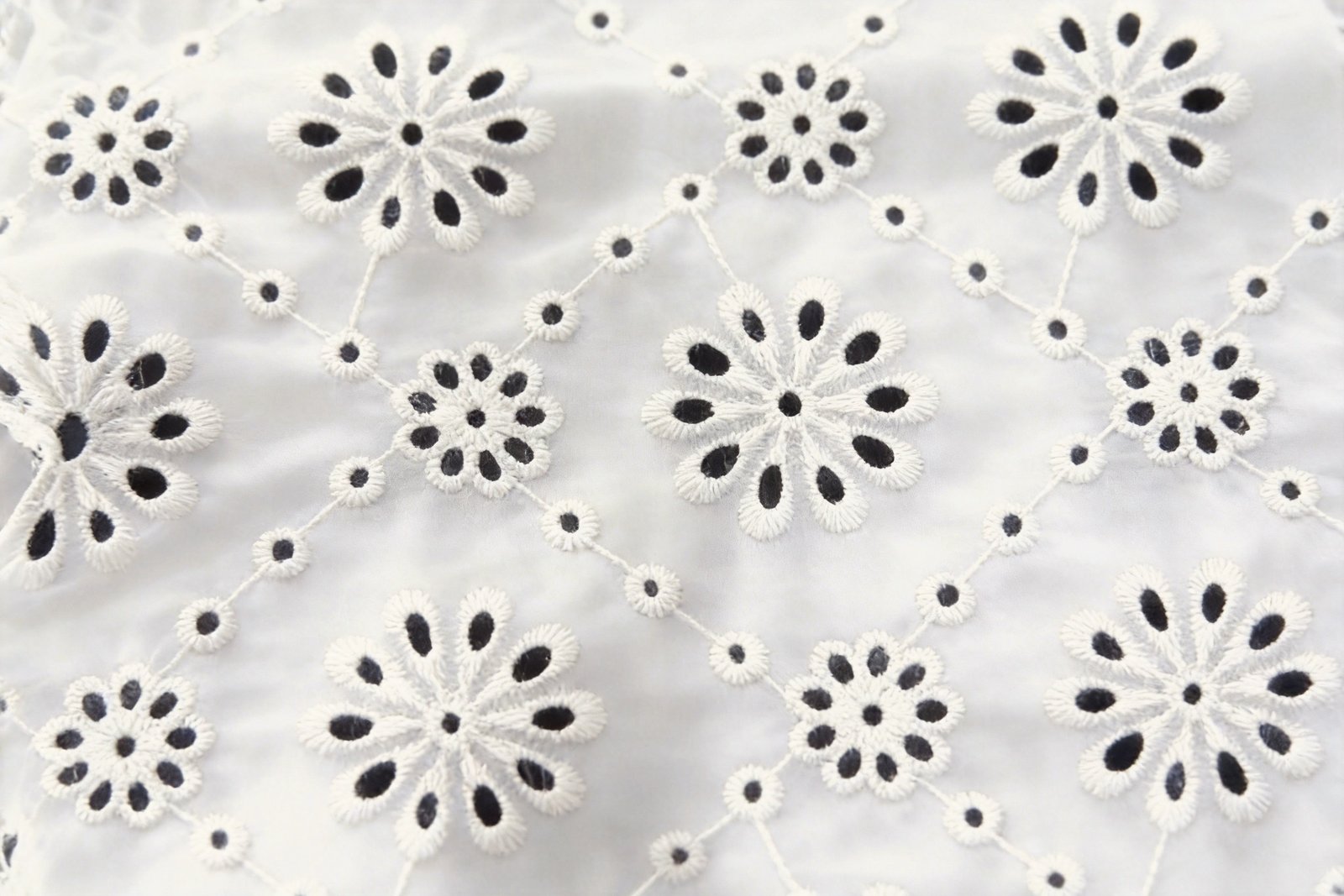
Continuous all-over embroidery that covers the whole ground — maximal openwork texture for dresses, skirts and bridal pieces.
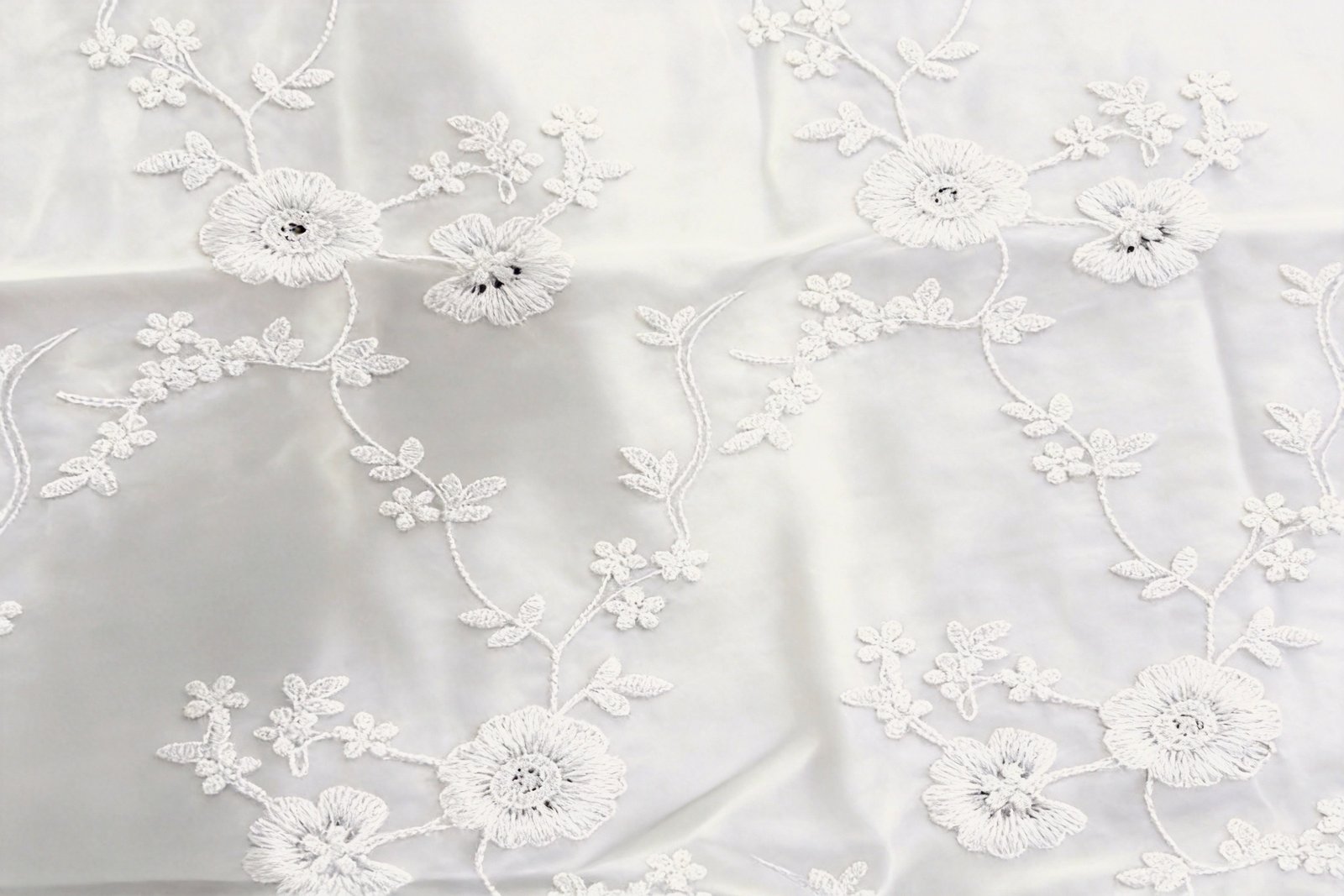
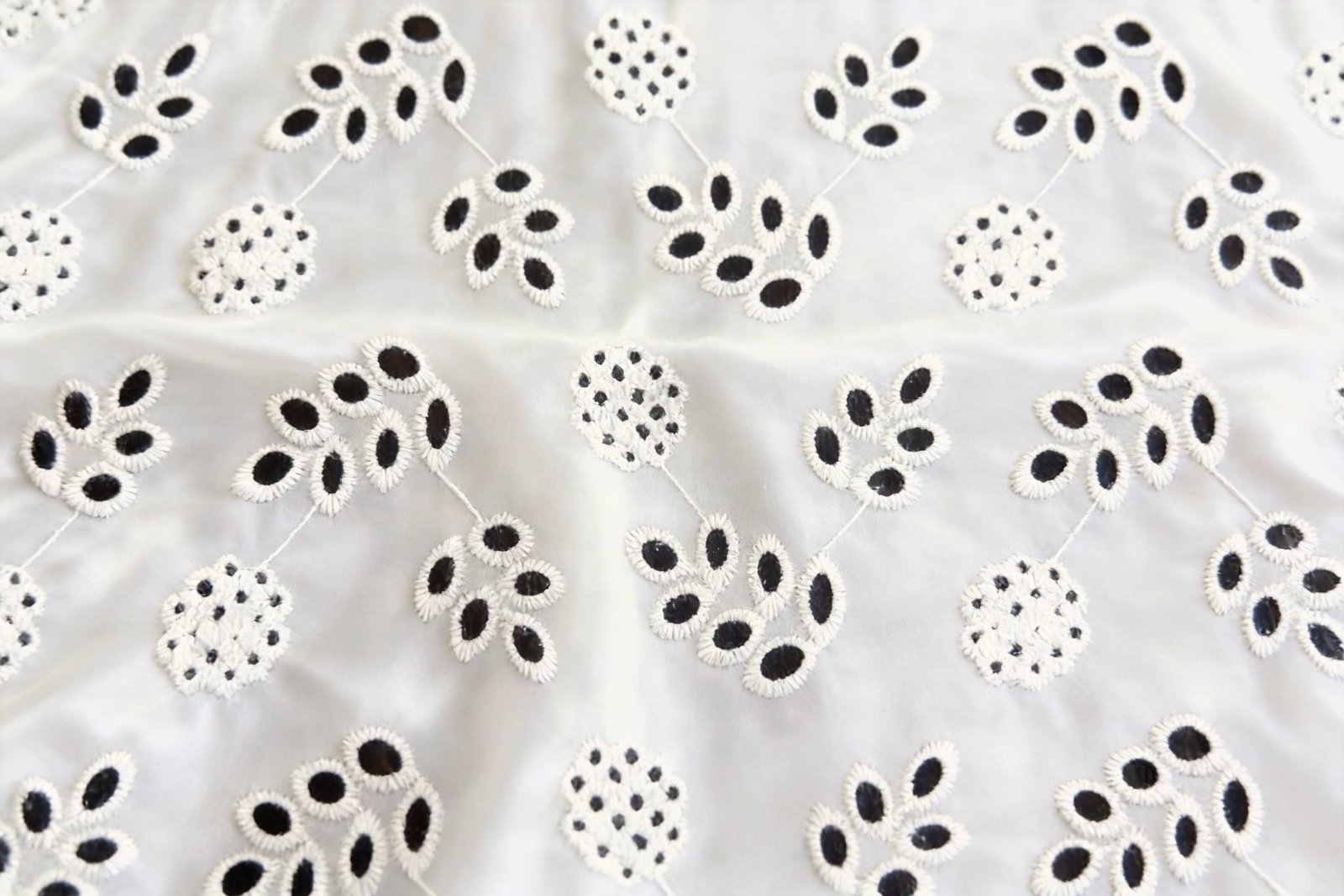
Motifs set widely on clean open ground — lighter hand feel, more negative space, ideal for blouses and summer kids’ wear.
FABRIC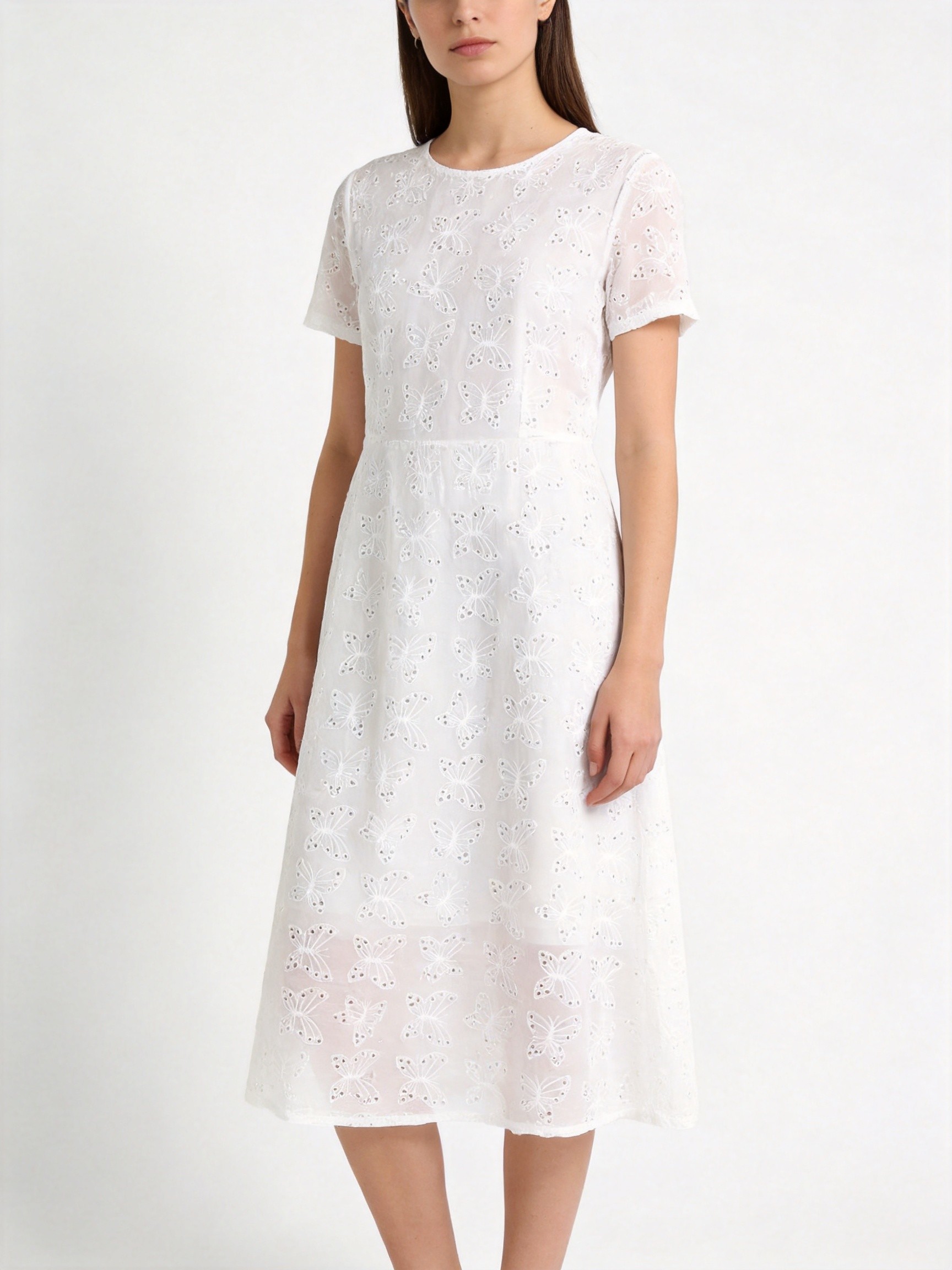 GARMENT
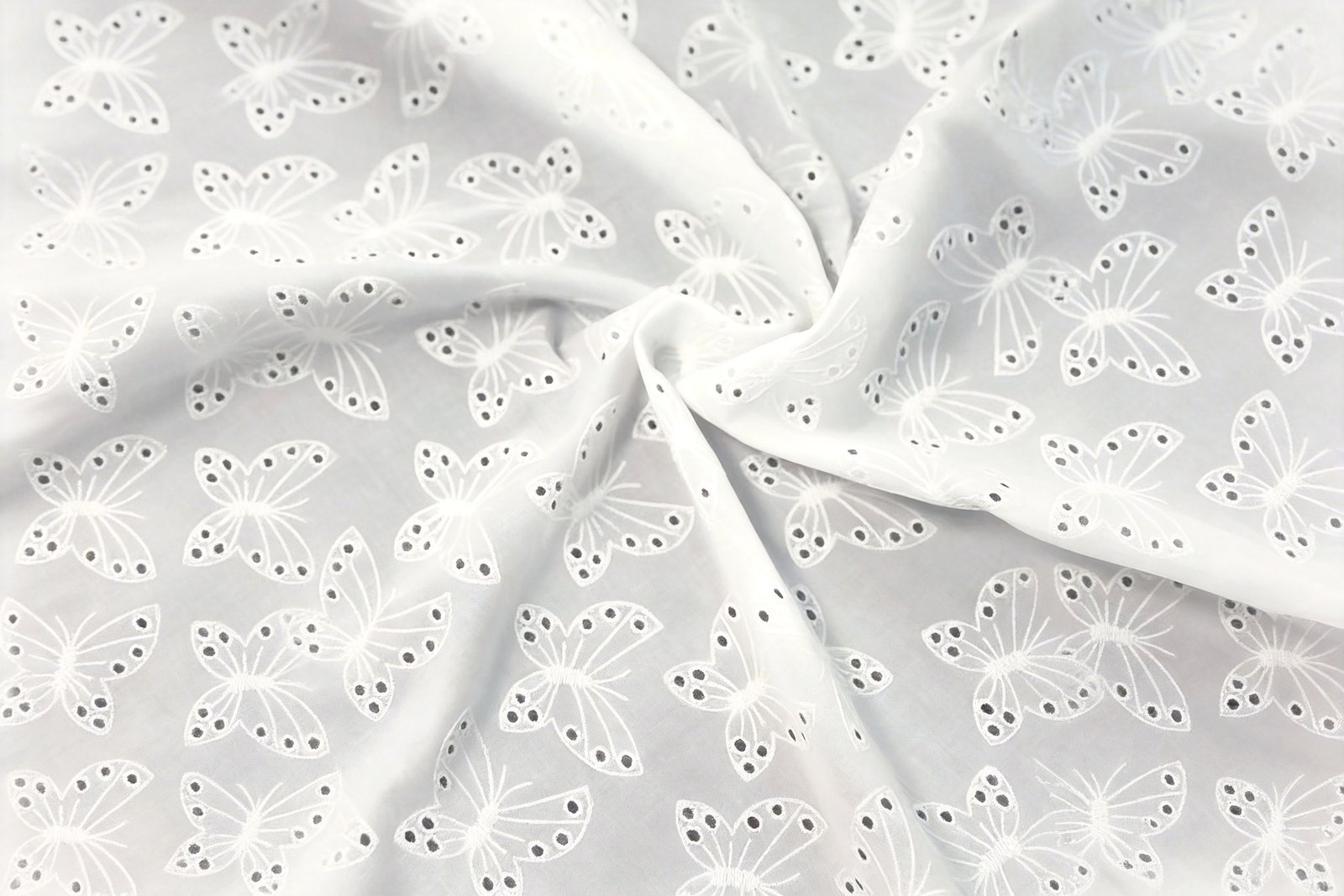
All-over dainty butterfly eyelets on a crisp white ground.
FABRIC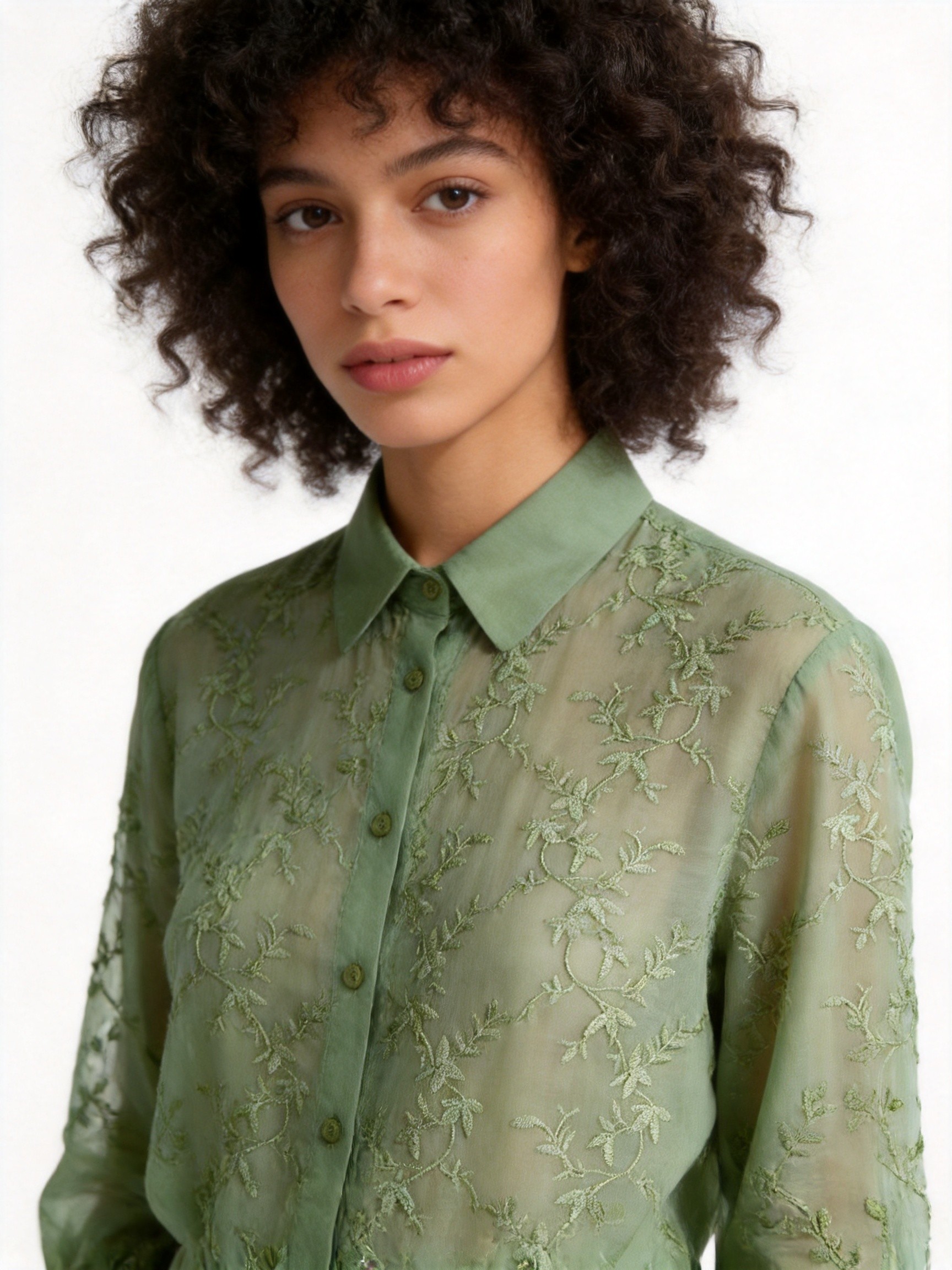 GARMENT
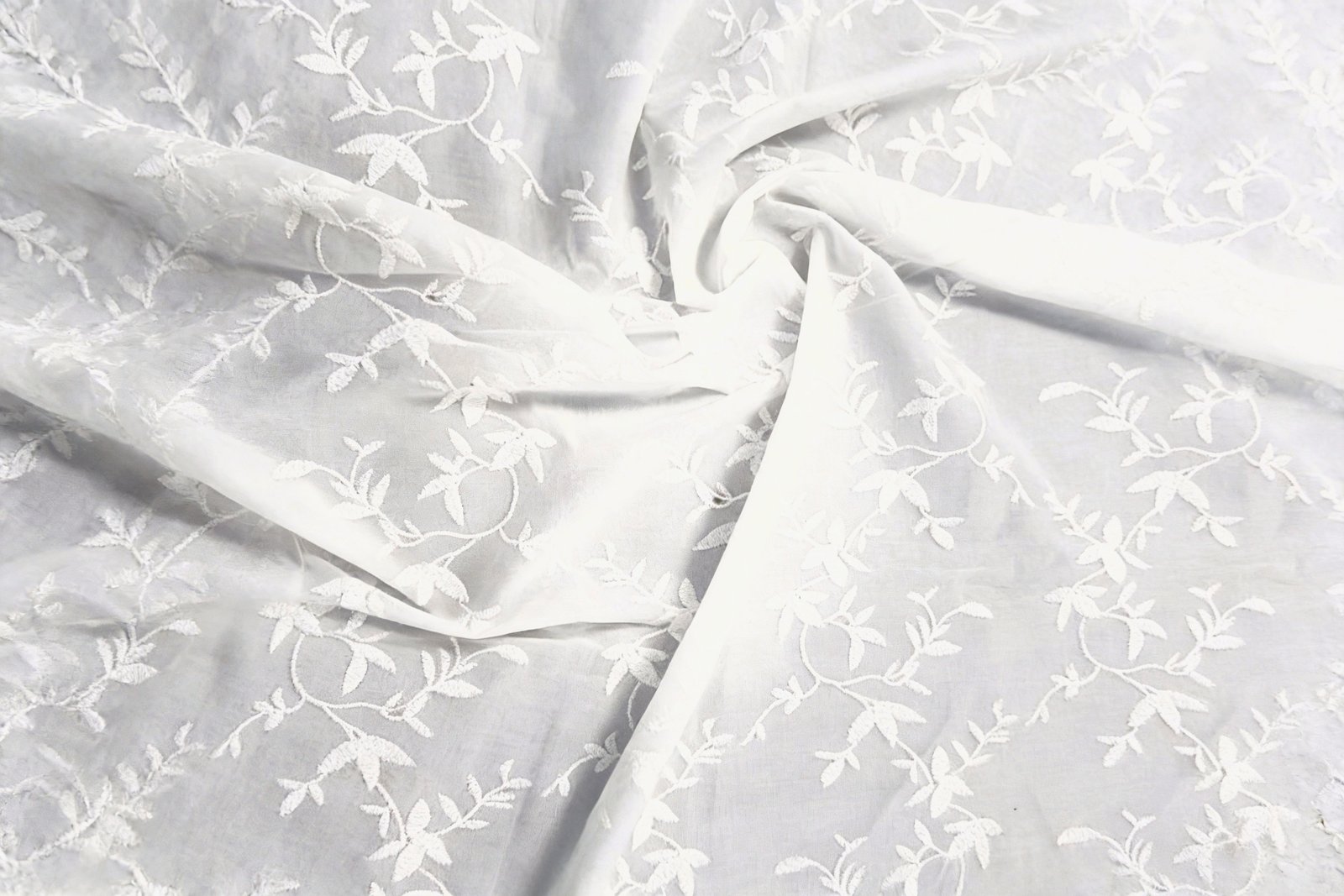
Sparse sprigs of tiny cutwork leaves on an open ground.
FABRIC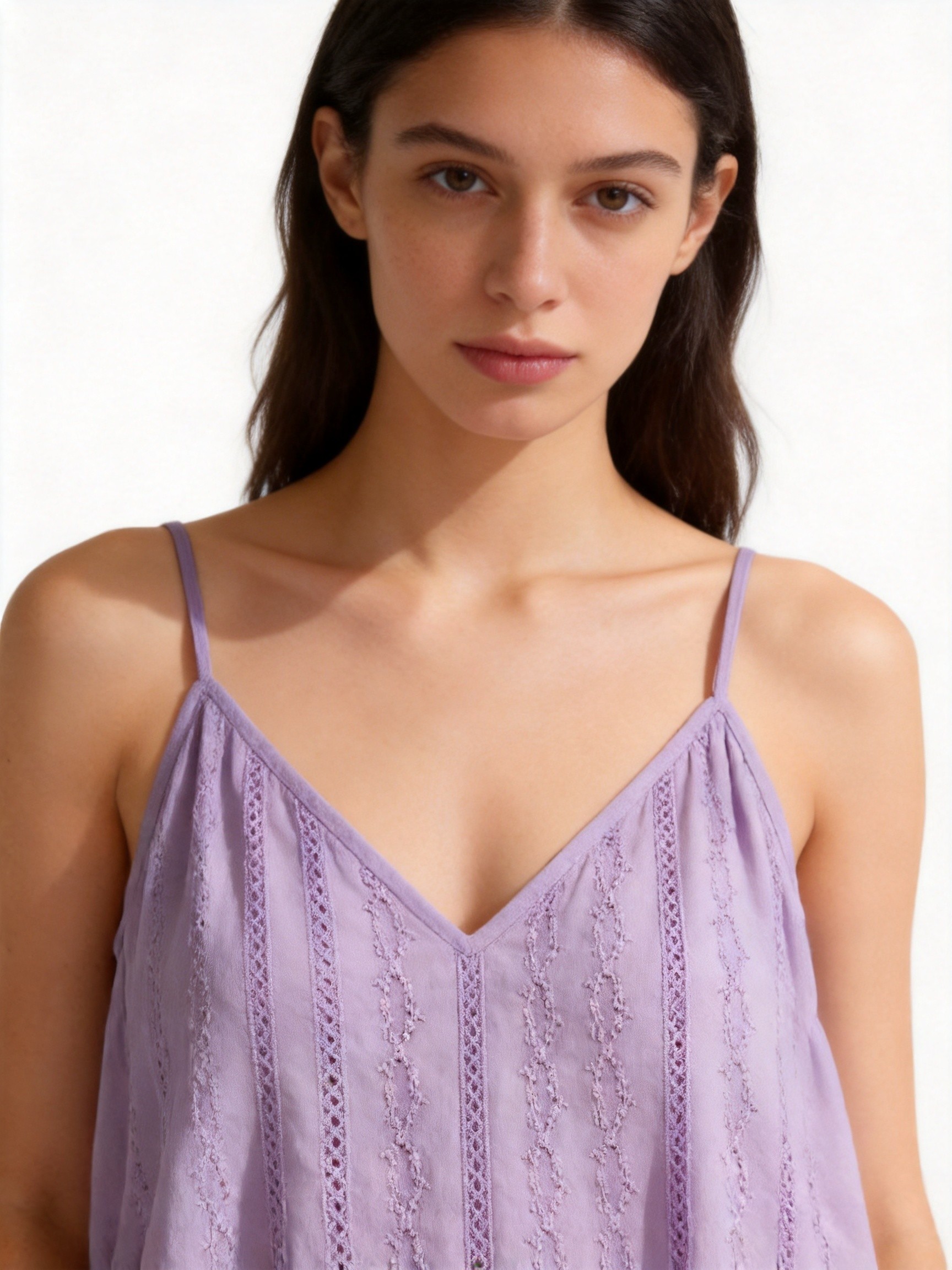 GARMENT
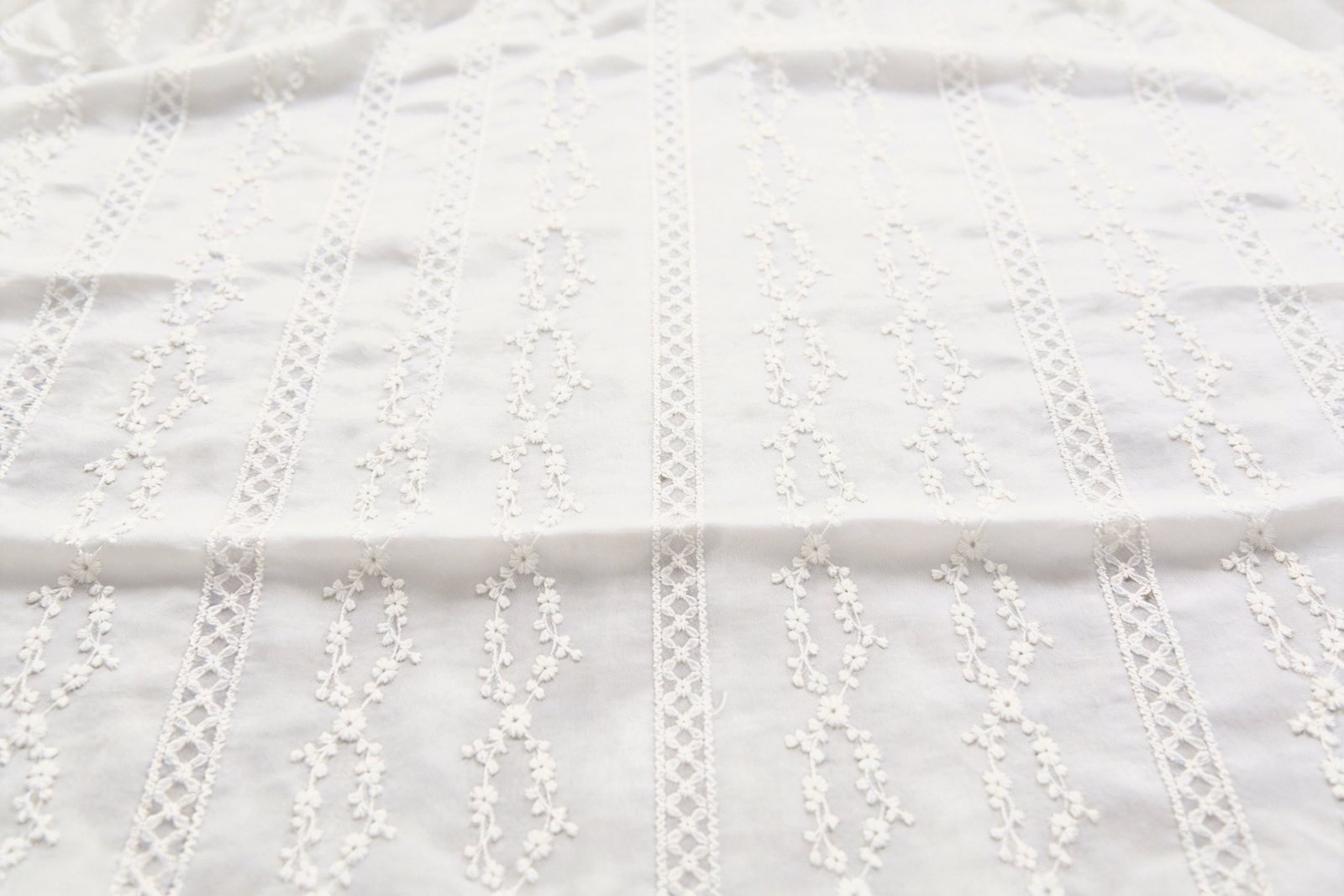
Open-ground climbing vines arranged in soft vertical stripes.
FABRIC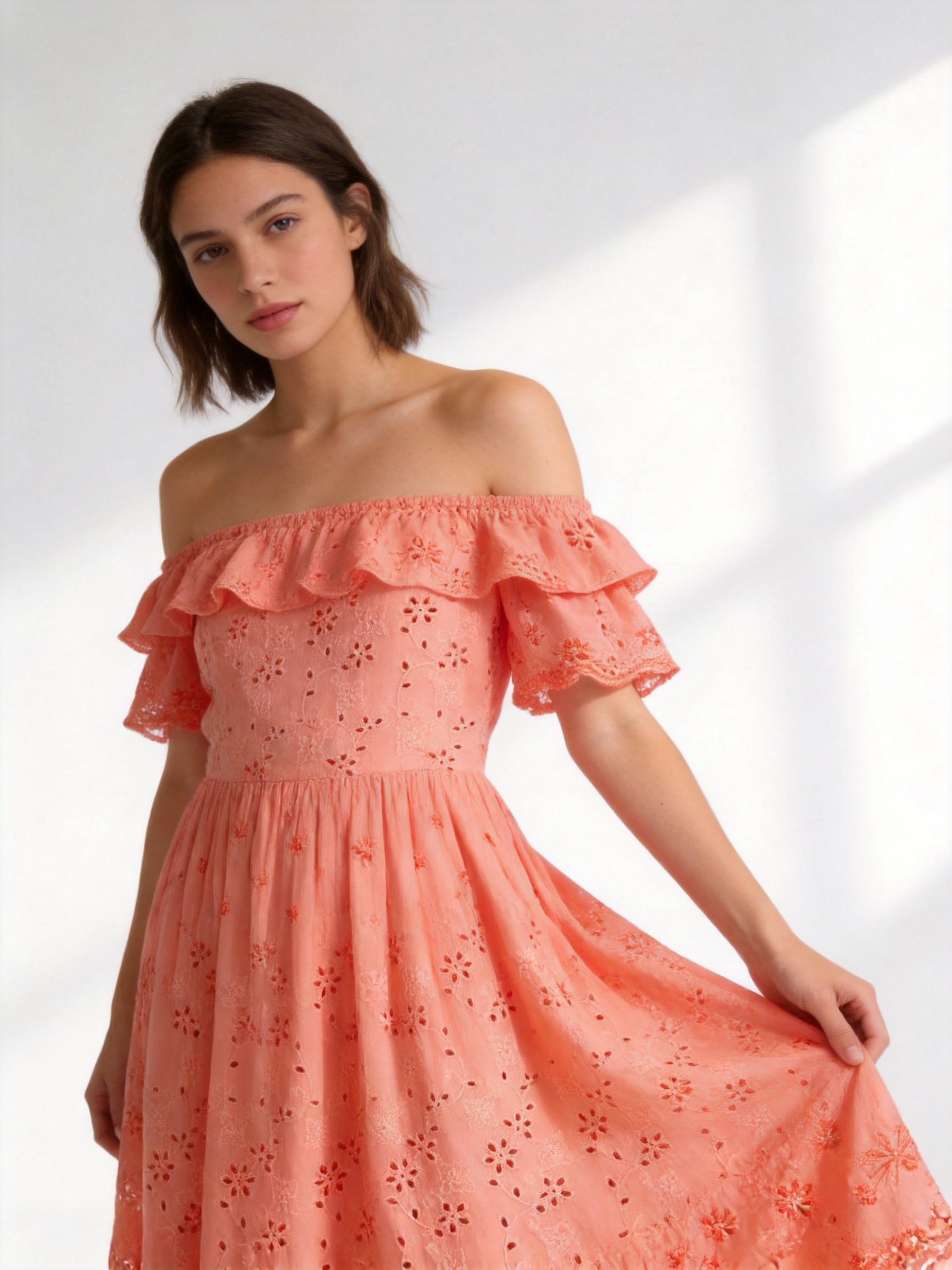 GARMENT
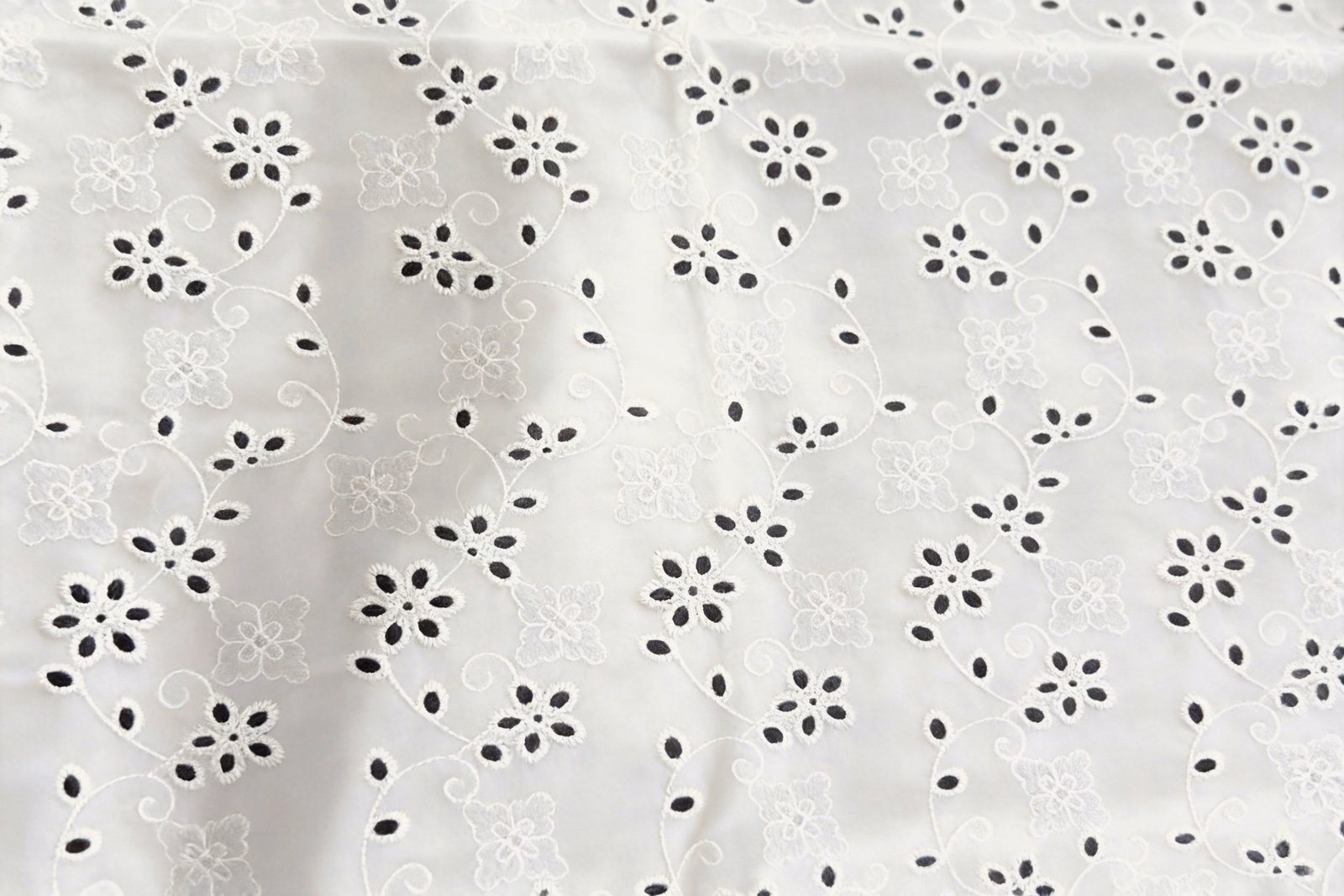
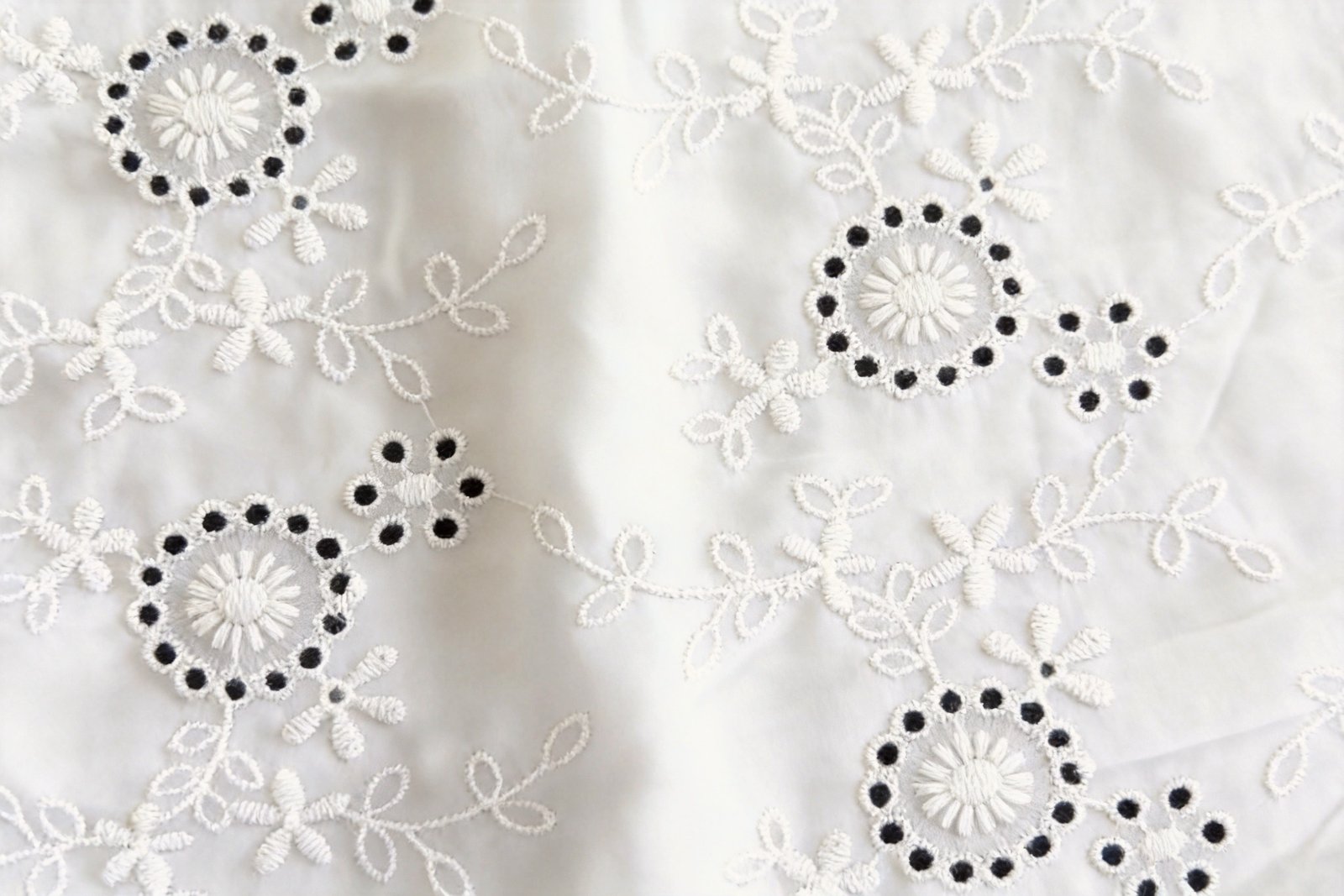
Classic scrollwork vines with five-petal eyelet flowers.
FABRIC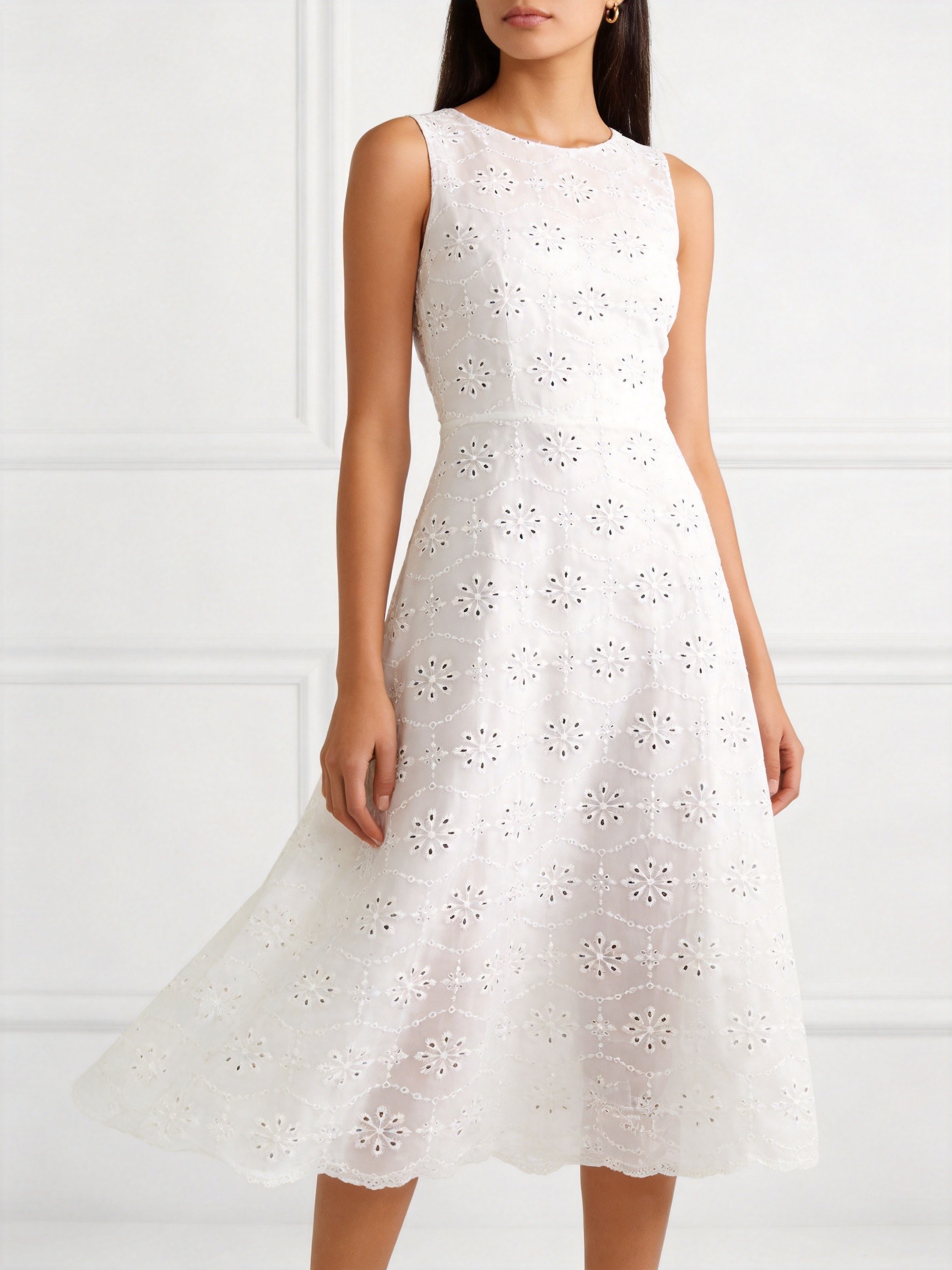 GARMENT
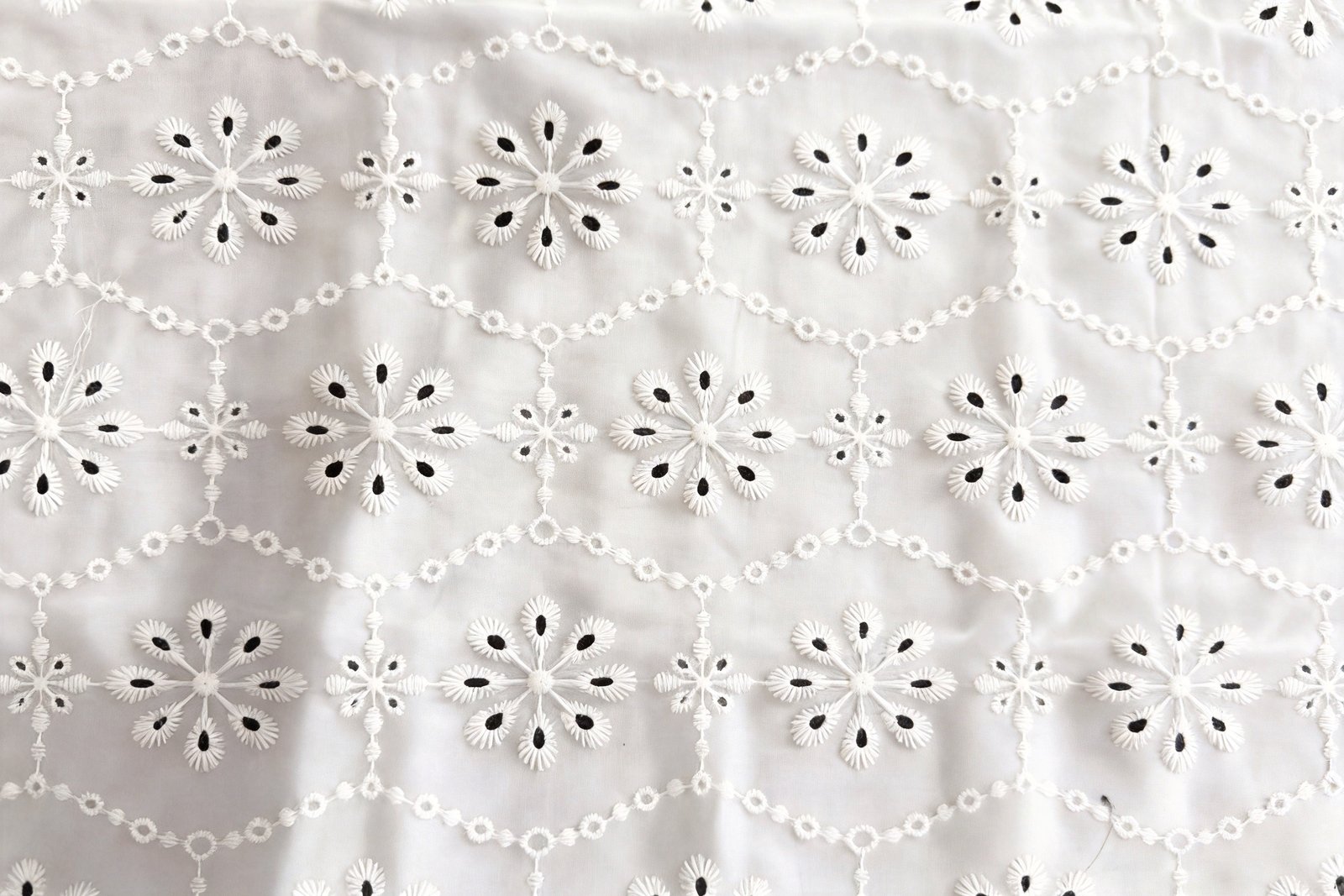
Full-density star medallions linked by lace lattice chains.
FABRIC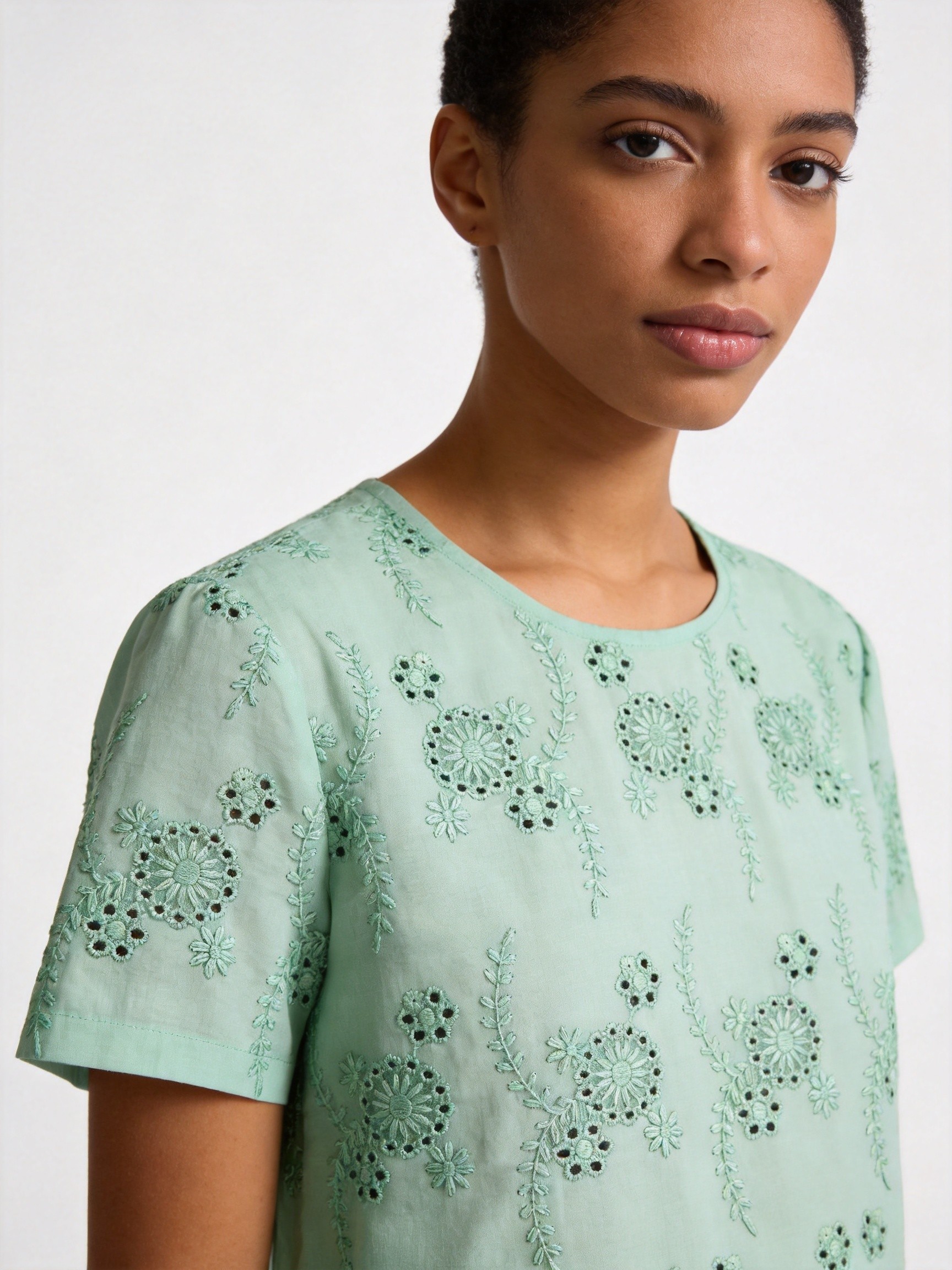 GARMENT
Drooping chrysanthemum sprays spaced widely on a sheer ground.
FABRIC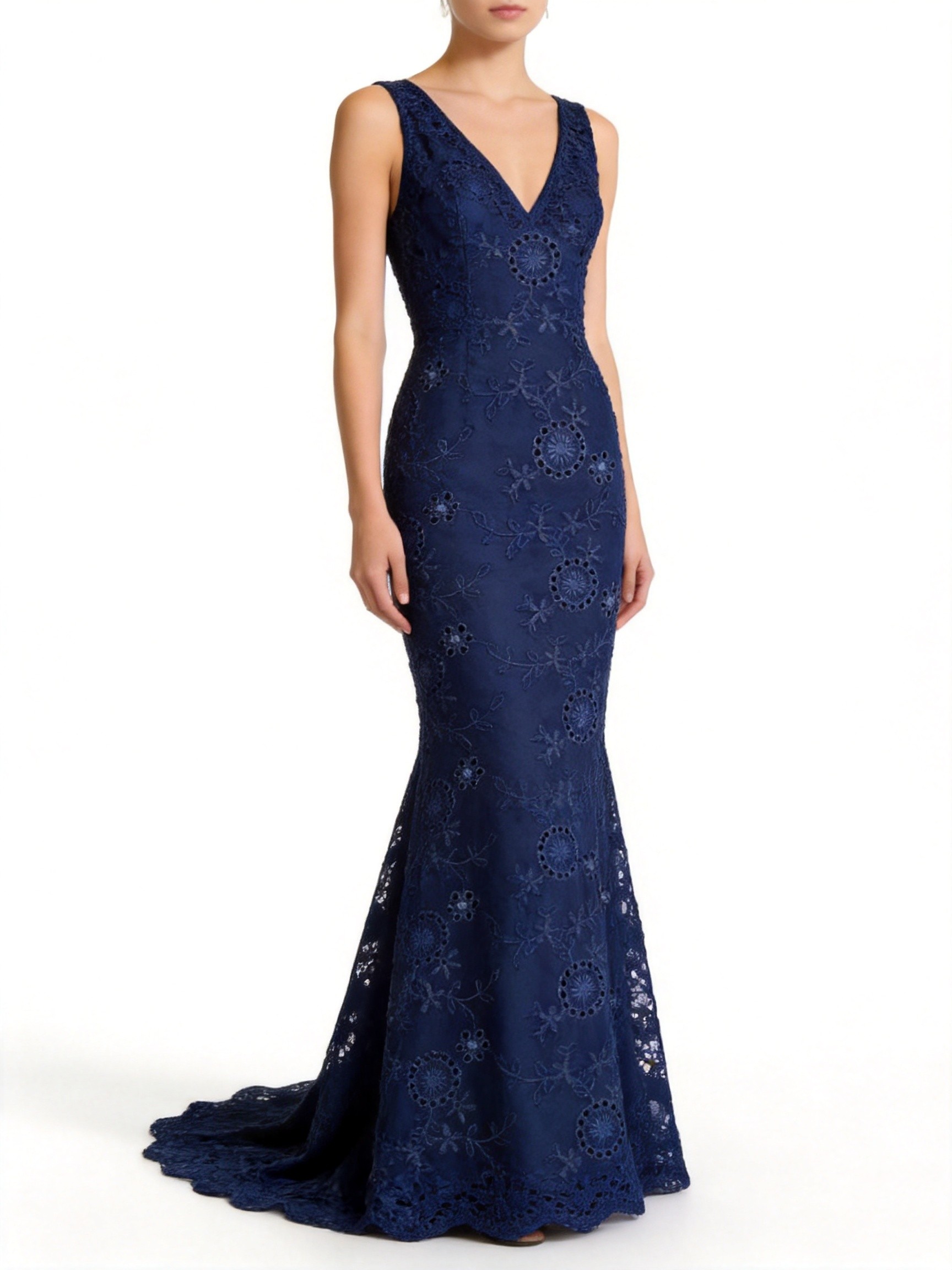 GARMENT
Factory code B21 — open ring medallions with cut-out dot borders.
FABRIC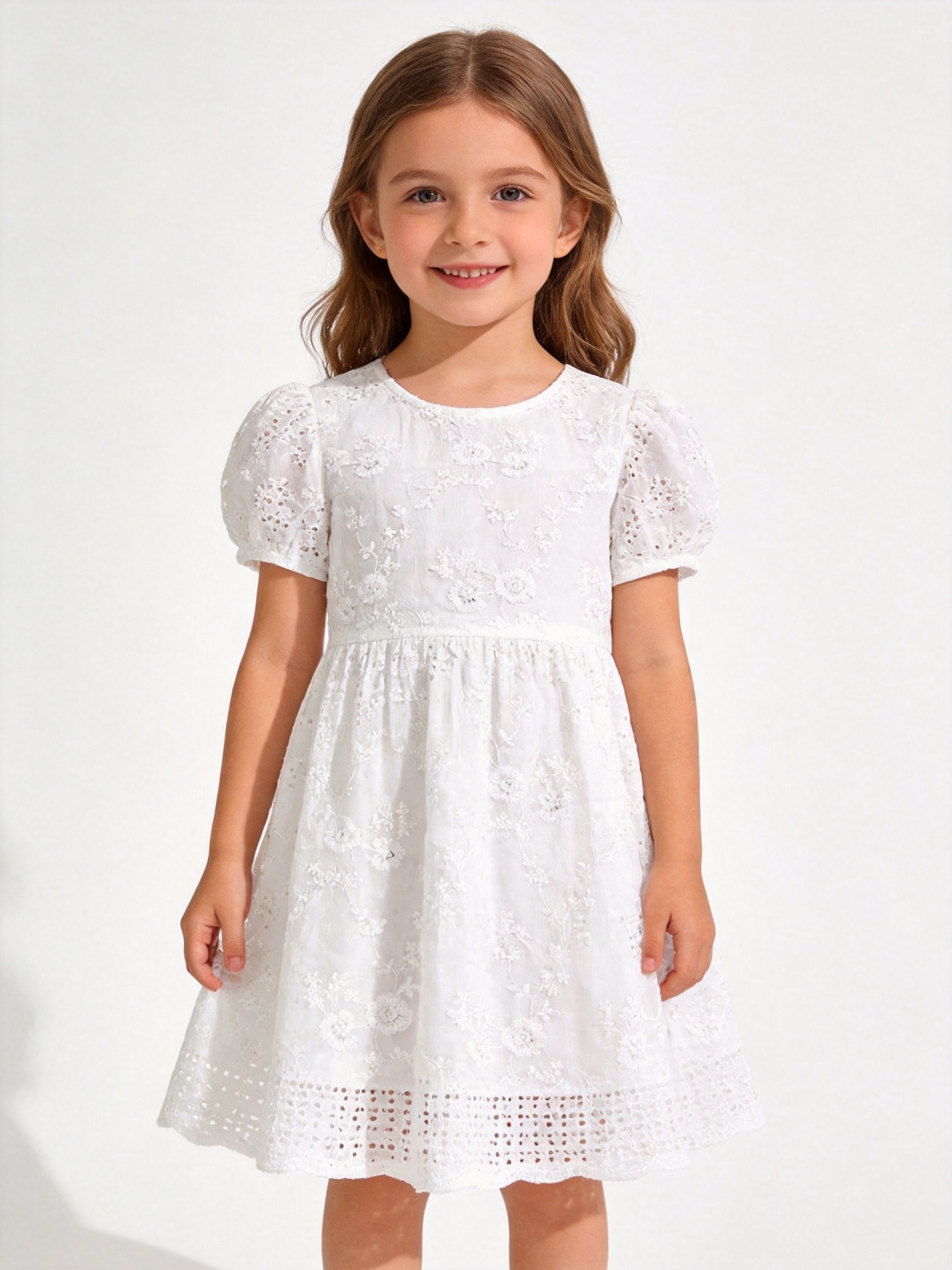 GARMENT
Large statement blooms on winding branches, generous negative space.
FABRIC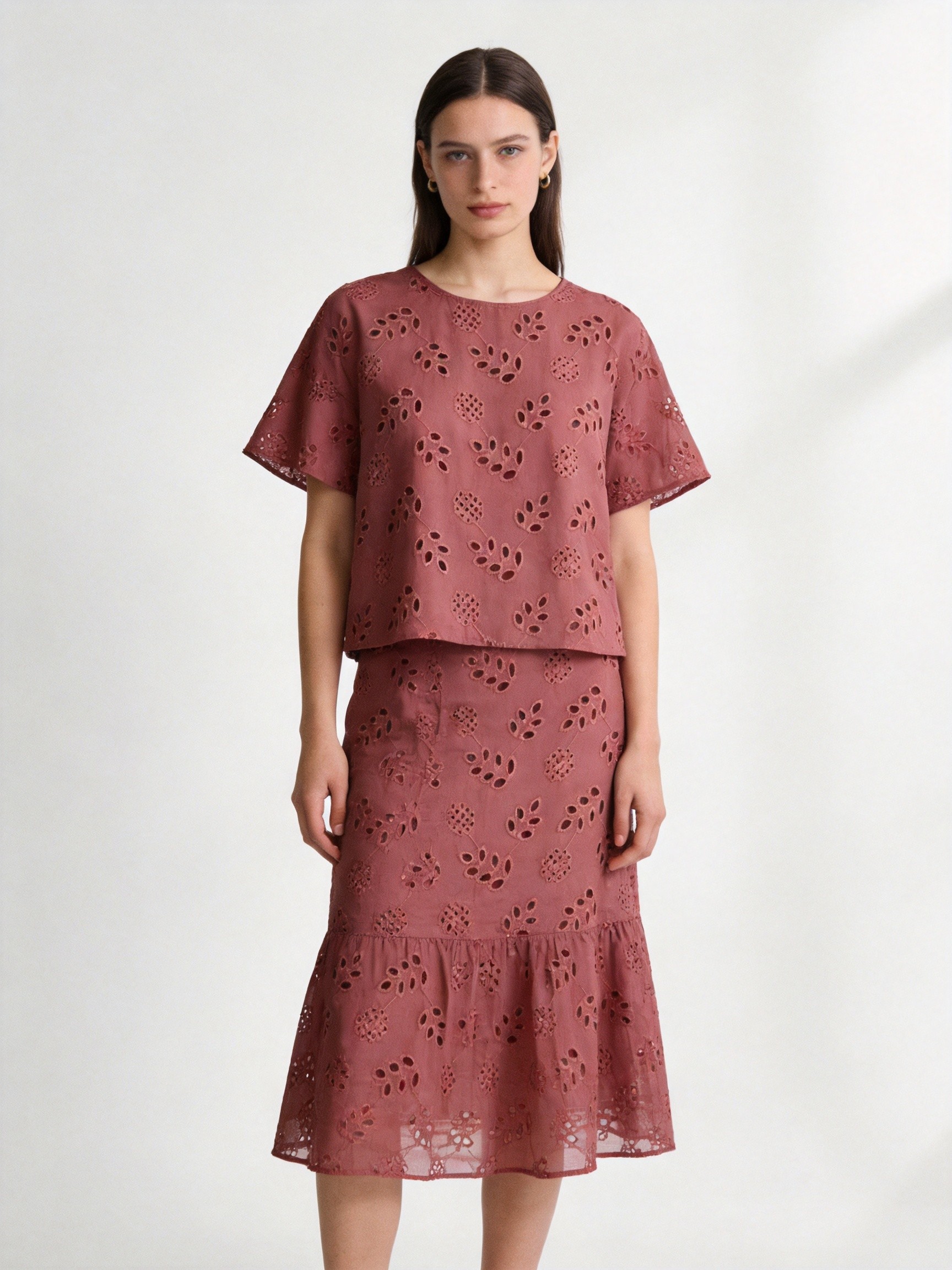 GARMENT
Small dotted posy clusters scattered across an open base.
FABRIC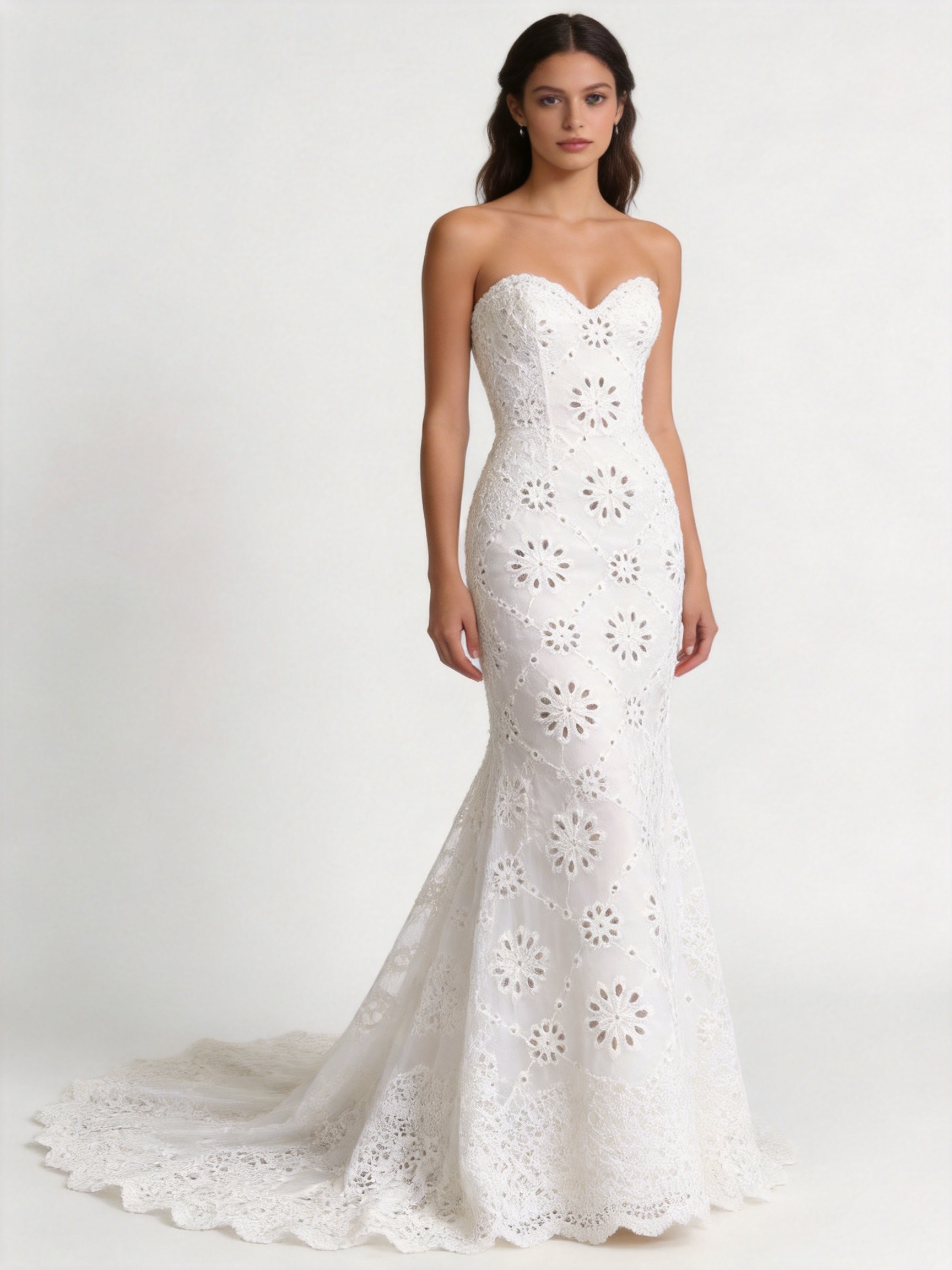 GARMENT
Full-cover radial flowers joined by diamond picot netting.
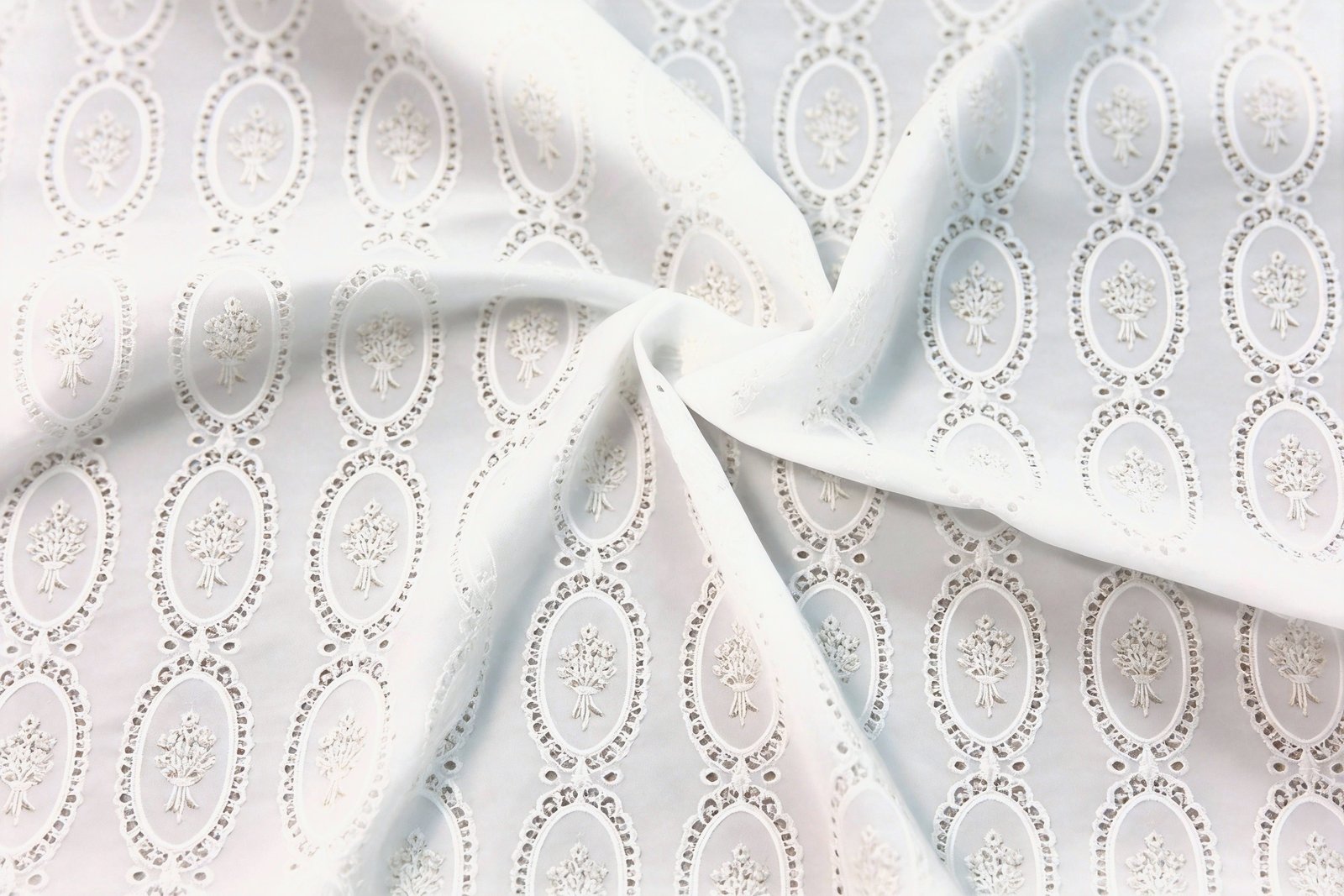
FABRICRepeating oval floral wreaths, densely embroidered all over.
Cotton eyelet is a warm-weather staple in women’s, kids’ and baby fashion, and a perennial bridal and lingerie fabric.
Romantic eyelet blouses and shirts — a spring/summer bestseller in EU and US markets.
Sundresses, midi skirts and matching sets with natural feminine texture.
Girls’ dresses, rompers and sets in soft breathable cotton cutwork.
Lightweight christening gowns, rompers and accessories (Class-I testing on request).
Wedding dresses, veils overlays and formal wear with a lace-like hand.
Camisoles, nightgowns and bralettes in airy embroidered cotton.
Beach kaftans, cover-ups and resort tunics.
Cushion covers, curtains, table linens and decorative panels.
| Item | Broderie Anglaise / Cotton Eyelet Embroidery |
|---|---|
| Composition | 100% Cotton |
| Fabric Weight | 100–130 GSM |
| Usable Width | 135 cm |
| Color | Natural off-white (greige white); custom dyeing on request |
| Patterns | 11 designs E-01 to E-11 — 4 full-density + 7 open/sparse |
| MOQ | 300 meters per design |
| Lead Time | Within 10 days after order confirmation |
| FOB Price | US $2.3–2.7 / meter, according to designs, packing and quantity |
| Terms | FOB China port · T/T (L/C at sight for larger orders) |
| End Uses | Women’s blouses, shirts, dresses, skirts, kids & baby wear, bridal & evening wear, lingerie, home textiles |
Quick answers about broderie anglaise / cotton eyelet embroidery. Need more detail? Contact our team.
Broderie anglaise (literally ‘English embroidery’), also called eyelet fabric or cotton eyelet embroidery, is a cotton fabric decorated with white embroidery and small cut-out holes — eyelets — worked along the pattern. It is lightweight, breathable and typically off-white, widely used for blouses, dresses, children’s wear and bridal garments.
Full-density all-over eyelet (our E-01, E-03, E-06, E-11) covers the fabric continuously with embroidery for a rich lacy look. Open/sparse embroidery (E-02, E-04, E-05, E-07, E-08, E-09, E-10) places motifs far apart on clean ground, giving a lighter, airier hand feel and more negative space.
The collection is 100% cotton at 100–130 GSM with a usable width of 135 cm, in natural off-white. It is a woven cotton base embroidered and cut on Schiffli-type embroidery machines, then finished to keep the holes clean and the hand soft.
MOQ is 300 meters per design. FOB price is US $2.3–2.7 per meter depending on the design’s embroidery density, packing and order quantity. Lead time is within 10 days after order confirmation.
It is used for women’s blouses and shirts, summer dresses, skirts and sets, children’s and baby clothing, wedding and evening dresses, lingerie and sleepwear, plus home textiles such as cushion covers, table linens and curtains.
Yes. Stock designs run in natural off-white; piece dyeing to your color card can be arranged, and new embroidery patterns can be developed from your artwork with sampling before bulk. OEKO-TEX Standard 100 testing is also arranged on request.
Neither printed nor jacquard-woven: on a woven cotton base the openings are punched out first and their rims are then overcast with embroidery, so every eyelet is genuinely open to the light.
The cloth goes through five stages. The pattern is drafted on paper first, fixing the position, the diameter and the repeat of every opening. The marked cotton is then punched along the design line — round, oval or rectangular openings depending on the motif. Each rim is bound with a dense buttonhole-type overcast stitch that wraps the freshly cut yarn ends so they cannot fray. Thread plugs left inside the opening are cleared out, so the hole is fully open rather than half closed. Finally the piece is washed, heat-set and inspected.
Hold the fabric up to a window and you see straight through it. That is the essential difference from an eyelet print: a print lays a hole-shaped graphic on intact cloth, whereas broderie removes the cloth and then closes the cut edge with thread.
Because the openings are made by embroidery, the ground between them stays intact, so one meter carries both the transparency of openwork and the body of real cotton. It is not as sheer as lace and not as flat as a plain weave: on the full-density designs (E-01, E-03, E-06, E-11) the openings almost touch and the look comes close to lace, while on the open/sparse designs (E-02, E-04, E-05, E-07, E-08, E-09, E-10) more ground shows and the fabric reads as an embroidered cotton.
100–130 g/m² (GSM) sits in the light range and the usable width is 135 cm. Where a lot falls inside that band changes the hand noticeably.
Towards 100 g/m² the cloth is thin, quite transparent and slightly drier to the touch — fresh for spring/summer blouses, shirts and beach cover-ups, but sheer in a single layer, so it needs a lining or a two-layer construction. Towards 130 g/m² the yarn sett is denser and the cloth gains a light crispness, which holds the drape better; that end suits dresses, skirts and kids' wear because it does not cling to the body.
Either way 100% cotton keeps its character: it absorbs moisture, it breathes and it stays soft on the skin. Because the overcast stitch passes through the yarns around each opening many times, however, the cloth immediately around a hole is a little firmer than the ground between motifs. That is a normal result of the process and not a quality fault, and it softens once the garment is washed.
A 135 cm width is comfortable to cut: a blouse, a skirt or a dress lays out inside it without joining the pattern. Directional designs such as E-04 "Vertical Stripe Vine" are better cut parallel to the design direction; mixing directions in the cutting room leaves the eyelet direction inconsistent inside one garment, and it looks as though two different fabrics were joined.
Four designs run full density and seven run open. The right choice depends on whether the eyelet is the hero of the garment or only a texture behind it.
Choose full-density all-over eyelet — E-01 Butterfly, E-03 Oval Wreath, E-06 Snowflake Star, E-11 Radial Large Flower — when the fabric is the product: dresses, skirts, bridal, overlays, occasion pieces. The openings nearly connect, so a single layer already reads as lace and the lining carries the opacity.
Choose open/sparse embroidery — E-02 Trailing Tiny Leaves, E-04 Vertical Stripe Vine, E-05 Scrollwork Eyelet, E-07 Chrysanthemum Spray, E-08 Ring Medallion, E-09 Trailing Large Bloom, E-10 Dot Posy — for garments worn every day: shirts, kids' wear, baby wear, sleepwear, home textiles. Clean ground dominates, transparency is dotted rather than overall, and seams and topstitching disappear into the fabric more easily.
Two rules. Keep two designs from one order in the same group: a close density stops panels sewn together from reading as two different shades, whereas a dense design beside a sparse one tends to make the sparse one look washed out. If you do cross the groups — dense body, sparse sleeve — compare the A4 swatches side by side in daylight first, because photographs usually understate how present the dense designs are.
Every eyelet rim is a cut edge wrapped in thread. These few points keep it intact after cutting, sewing and washing.
Pre-shrink before cutting. Cotton shrinks: wash the roll once, or run a small sample through the same finishing wash, so the measurements and the shape of the openings do not change after the garment is washed.
Use a fine needle — size 9–11 with ticket 60–80 thread and a slightly shorter stitch length. Never stitch across the middle of an eyelet: keep the seam on the ground between two openings. For joins and edges use an overlock or a closed seam that covers the cut edge completely, because once the yarns slip at an opening rim the whole motif unravels.
Do not stretch the openwork. On collar, sleeve setting and zips, keep stitching in the least open areas and, on sparse designs, between motifs; on dense designs back the stress points with a light fusible or a strip of stay tape.
Wash cold or below 30 °C in a laundry bag with a mild detergent, no bleach, no hard wringing. Low-heat tumble dry or line dry in the shade. Press with medium steam and a thin pressing cloth, never with the soleplate straight on the eyelets — pressure flattens the rims and the holes lose their look. And line it: at 100–130 g/m² a single layer is sheer, so women's blouses and dresses need a matching cotton lining or a two-layer build, while kids' and baby wear is better with a softer combed cotton lining.
All 11 designs are stock items: MOQ 300 m per design, a free A4 swatch, production within 10 days and FOB US$2.30–2.70 per meter.
MOQ is 300 meters per design — several hundred ordinary blouses or women's dresses, which fits a brand's first order, a small designer run and fast replenishment. All 11 designs are stock, so no pattern has to be re-opened, and that is exactly why small quantities are possible.
Sampling: a real A4 swatch is free and posted anywhere in the world, so you can feel the hand, check the openings against the light and compare the shade. Dyed samples or the development of a new pattern are quoted separately against your colour card and artwork, and they take longer than a stock swatch.
Lead time is within 10 days after order confirmation. FOB runs between US$2.30 and US$2.70 per meter depending on embroidery density, packing and quantity: full-density designs need more stitches and sit at the top of the band, open/sparse designs at the bottom. Payment is T/T; L/C at sight can be discussed for larger orders. Production runs in our own mill in Zhuji, Zhejiang, near the Keqiao cluster, so fixing design number, quantity and packing before you ask for a quotation gets price and delivery date right the first time.