Introduction
A garment can fail in the customer's hands even when the mill shipped perfect fabric — through a care label that tells the consumer the wrong story. Every returned shirt that "shrank two sizes," every corduroy jacket that "lost its pile," every quilted piece whose print faded after three washes is a chargeback against your brand's review score. Most of these complaints are preventable at two points: engineering the right finish into the fabric (sanforizing, pre-washing, color-fast dyeing) and writing accurate, fabric-specific care instructions for the label.
This guide explains the international care-label symbol system (ISO 3758, used across Europe, Asia and much of the world, with the US ASTM system nearly identical), gives fabric-by-fiber and fabric-by-construction care guidance for the cotton-rich woven categories a Keqiao mill ships — poplin, corduroy, canvas and twill, linen-cotton and quilted cotton — and breaks down the three classic failure mechanisms: shrinkage, fading and pilling. It closes with practical advice for brands on writing care copy, testing instructions before printing labels, and aligning fabric specs with the promised wash routine.
1. Why Care Instructions Are Part of Product Quality
Legally, care labeling is a compliance matter. In the EU, care instructions are not universally mandated under one directive the way fiber composition is (Regulation 1007/2011 covers composition), but national consumer-law regimes — notably France's textile care-label requirements and Northern European consumer protection practice — plus every major retailer's vendor manual require correct, harmonized symbols. In the US, the FTC Care Labeling Rule requires manufacturers and importers of most wearing apparel to attach a permanent label with at least one reasonable care method, using either the ASTM symbols or words. Australia mandates care labeling under consumer law. Practically, the care label is a warranty: it tells the customer what the product is engineered to survive, and it is your defense in a complaint.
The cardinal rule: the label must reflect the least durable component. A 100% cotton poplin body with a fusible interlining that cannot take 60 °C is a 30–40 °C garment. A quilted cotton with a resin-bonded batting that tolerates no tumble heat is a line-dry product. Test the finished sewn article, not the face cloth alone.
2. The Care Symbol System, Decoded
The ISO 3758/ASTM D5489 symbols use five pictogram families. Treat the temperatures and dots below as the standard values printed on modern labels.
Washing — a washtub
| Symbol | Meaning |
|---|---|
| Tub with hand | Hand wash only (max 40 °C, gentle handling) |
| Number in tub (30 / 40 / 60 / 95) | Machine wash at that maximum temperature °C |
| One bar under tub | Synthetics/medium cycle (reduced agitation) |
| Two bars under tub | Gentle/delicates cycle (minimum agitation) |
| Tub crossed out | Do not wash — dry clean only |
Bleaching — a triangle
Plain triangle = chlorine and oxygen bleach allowed as needed; triangle with two diagonal lines = only oxygen/non-chlorine bleach when needed; crossed triangle = do not bleach. Deep-dyed cotton and elastane blends nearly always take the lined triangle (no chlorine), because sodium hypochlorite attacks spandex, yellows resin finishes and strips reactive dyes.
Tumble drying — a square with circle
Plain = tumble dry allowed; one dot = low heat; two dots = medium/high heat; filled circle = no heat/air only; crossed = do not tumble dry. Natural-drying symbols fill the same square differently: vertical line = drip dry line dry hanging; horizontal line = dry flat (heavy wovens, knits and quilts that would stretch on a hanger); two diagonal top-corner lines = dry in shade (protects reactive and especially pigment prints from UV fade).
Ironing — an iron
Dots encode sole-plate temperature ceilings: one dot ≈ 110 °C (synthetics, nylon, acetate, fabrics with elastane trims); two dots ≈ 150 °C (wool, polyester blends, viscose); three dots ≈ 200 °C (cotton, linen). Crossed iron = do not iron. Iron with dots of steam beneath crossed out = do not steam (some finishes and pile fabrics). For reference, common fiber damage temperatures: nylon can glaze from ~150 °C, polyester shines around 150–180 °C depending on heat-set history, cotton and linen tolerate ~200–220 °C when damp, and elastane performance degrades with repeated heat above roughly 150 °C.
Professional care — a circle
Plain circle = dry clean; letters inside (P, F, W) tell the professional which solvent or process: P = perchloroethylene and listed solvents standard process; F = hydrocarbon solvents only (more delicate); W = professional wet cleaning. Crossed circle = do not dry clean. A circle under a single bar means mild professional treatment; under two bars, very mild. Dry-clean-only is required when construction (tailored pieces, some fusibles, certain pile or printed effects) rather than fiber cannot survive water — fiber alone rarely demands it for plain cotton.
| Category | Typical label for cotton-rich wovens | Typical max iron temp |
|---|---|---|
| Cotton poplin shirts | Wash 40 °C, no chlorine bleach, tumble low or line, iron 200 °C | ~200 °C (three dots), steam OK |
| Pigment/digital print cotton | Wash 30 °C inside out, oxygen bleach only, dry in shade, iron reverse 150 °C | ~150 °C on reverse |
| Corduroy | Wash 30–40 °C inside out, no tumble or low only, iron on reverse over pile | ~150 °C reverse / steam refresh |
| Canvas/twill workwear | Wash 40–60 °C, tumble medium, iron 200 °C | ~200 °C |
| Linen-cotton | Wash 30–40 °C gentle, reshape damp, iron hot while damp for a crisp finish | ~200–220 °C damp |
| Quilted cotton | Wash 30–40 °C gentle with mild detergent, dry flat/low, avoid wringing | ~150 °C if needed over cloth |
| Stretch (2–3% elastane) | Wash 30–40 °C, no chlorine, low/no tumble, iron ≤ 150 °C avoiding direct pressure on elastane areas | ~150 °C max |
3. Fabric-by-Fabric Care: The Six Cotton-Rich Categories
Cotton poplin (shirting, prints, blouses)
Poplin's tight plain weave and fine yarns wash beautifully but show every wrinkle. Machine wash warm (30–40 °C for colors, up to 60 °C only for white goods where the dye and trims allow) with like colors; use oxygen bleach rather than chlorine to protect whites without degrading finishes. Tumble on low and remove slightly damp, or line dry — cotton is at its easiest to iron at residual moisture. Iron up to ~200 °C with steam, on the reverse for printed or lightly resin-treated cloth. Dark reactive-dyed shades should be washed cold the first 2–3 cycles to flush loose dyestuff. If the fabric is sanforized, residual shrinkage typically settles within about 3% across the first washes; unsanforized handloom-style or loose cotton can move far more. See our poplin print lines under the 8135 poplin print references.
Corduroy (pile construction, 100% cotton or cotton-elastane)
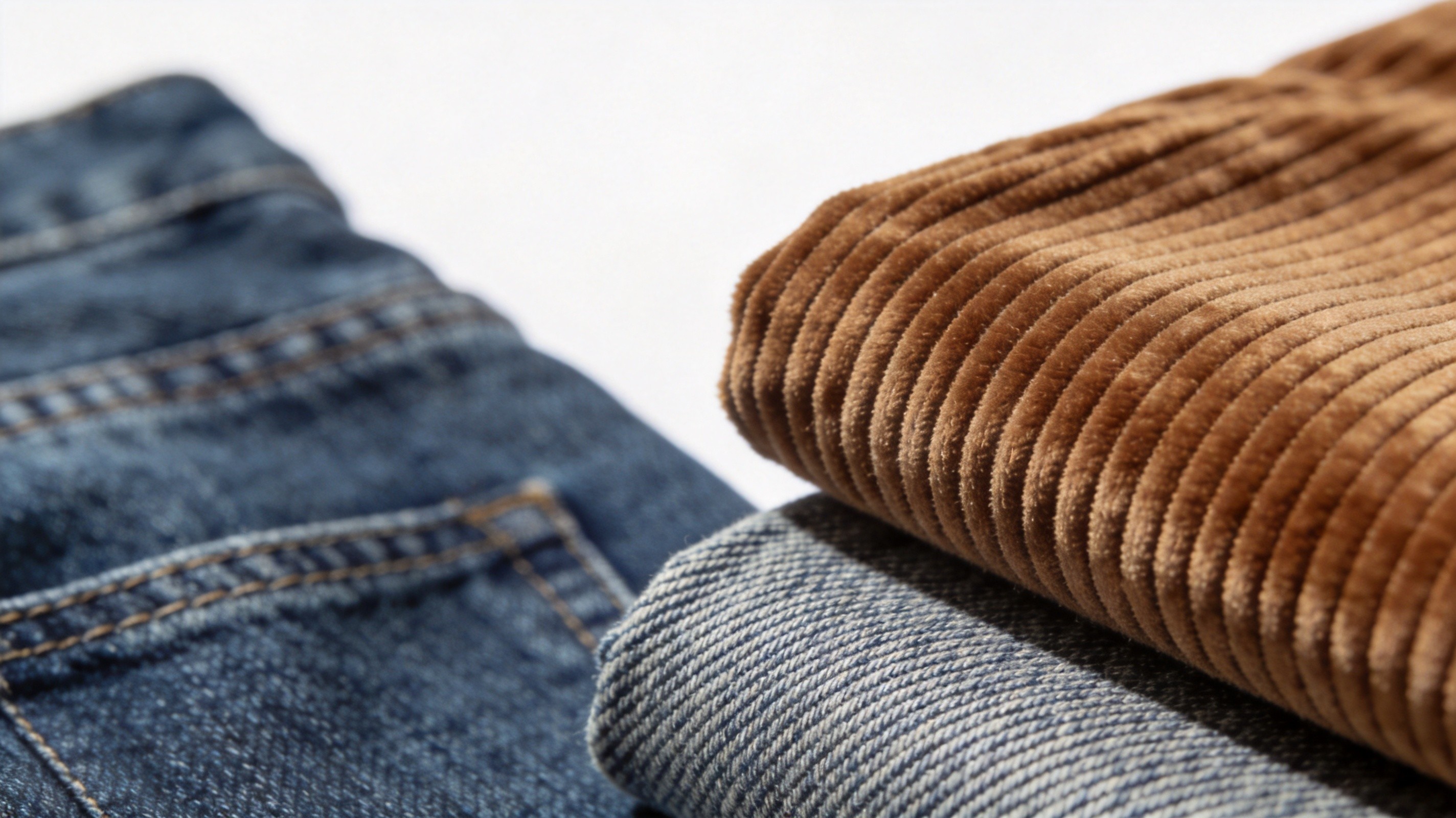
Corduroy's enemy is not water — it is crushing the pile and setting creases. Turn garments inside out before washing (zip zippers, button flaps), wash at 30–40 °C on a reduced-agility program with liquid or fully dissolved detergent — powder can catch in the wales — and never overload the drum. Shake out and smooth the pile direction immediately after washing; line dry or tumble on low with a clean dry towel to cushion, removing before fully dry. Do not iron face-down onto the pile: iron on the reverse over a needle board or a towel, or refresh with steam while brushing the wales. Avoid folding wet corduroy against itself for long periods (pile marks) and store heavy pieces hung or rolled rather than tightly folded. Deep shades crock most when new; one initial cold wash reduces rub-off. Stretch corduroy inherits elastane rules: no chlorine, low heat. We cover construction and wale types in the corduroy buyer's guide and wash behavior in the corduroy shrinkage and care guide.
Canvas and twill (workwear, bags, aprons, upholstery-weight)
Heavy cotton is robust but greedy: it absorbs a lot of water and detergent, takes long to dry, and — if unwashed at the make-up stage — shrinks hard on first wash, which is why bag and cover makers often buy pre-washed or pre-shrunk canvas. Wash 40 °C (60 °C for genuinely soiled workwear where dyes permit), tumble medium or line; expect progressive softening and character rather than damage. Iron hot with steam; heavy twill presses better damp. Dry cleaning heavy canvas is rarely necessary and can leave solvent odor. Two cautions: pigmented or waxed/oil-finish canvases are special cases needing spot-clean or dry-clean symbols, and garment-dyed canvas crocks heavily until washed separately in cold water the first few times. For typical weights and end uses see the heavy cotton twill and canvas guide.
Linen-cotton blends
The blend exists to make linen's virtues livable: 30–55% linen with cotton controls pure linen's 4–10% first-wash shock while keeping the dry, textured, cooling hand. Wash at 30–40 °C on a gentle cycle with mild detergent; never twist-wring — squeeze water out or spin briefly and reshape while damp. Two aesthetic paths follow drying: line dry and iron damp at ~200–220 °C for a crisp finish, or embrace the natural wrinkle and just steam. Linen-cotton softens and improves with washing; lint shedding on early cycles is normal, as is slight uneven slub relaxation. Dry flat heavy trousers to avoid seam drag. Chlorine bleach yellows lignin-bearing linen fibers — oxygen bleach only. Sand-washed linen-viscose variants need the gentler viscose regime (short spin, reshape damp, medium iron), covered in the sand-washed linen-viscose guide.
Quilted cotton (face + batting + backing)
Quilting introduces three materials and thousands of stitches, so care is about protecting the air layer. Wash at 30–40 °C on a bulky/gentle cycle with mild, non-enzymatic or fabric-appropriate detergent; use an extra rinse to clear soap from the filling; do not wring. Tumble on low with dryer balls or clean tennis balls to re-fluff the batting, checking often, or dry flat on a rack, turning and patting back into shape — hanging wet quilts strains seams. Avoid high heat: it can compact polyester batting, shrink cotton filling and faces differently (producing puckered panels), and damage bonded constructions. Spot-clean small marks; store fully dry, breathable, never sealed in plastic. Baby and skin-contact quilts should follow the stricter pH/formaldehyde profile from the start and be pre-washed in fragrance-free detergent. Construction options are detailed in the quilted cotton buyer's guide.
Stretch wovens and special cases
Any cotton-rich fabric carrying 2–5% elastane downgrades the heat story: wash ≤ 40 °C, no chlorine bleach, low or no tumble heat, iron ≤ 150 °C quickly, preferably on the reverse, and avoid prolonged local pressure (elastane can "spiral" and lose recovery after repeated thermal shock). Viscose-rich wovens should be handled gently when wet, with short spins and damp ironing; pigment prints want inside-out cold washing, shade drying and reverse ironing; metallic or coated effects are dry-clean/spot-clean territory unless tested otherwise.
4. The Three Failure Mechanisms — and How the Mill and the Label Prevent Them
Shrinkage
Cotton shrinks because spinning, weaving and finishing lock fibers and yarns under tension; warm water, detergent and mechanical action let them relax to a lower-energy geometry. Three factory-side interventions decide the number buyers see: sanforizing/compressive shrinkage (mechanical pre-relaxation, standard for shirting and trousers), pre-washing/garment-wash compatibility, and resin/easy-care finishing (trades some comfort for stability). Typical finished woven targets after three domestic washes are ≤ 3% warp/weft for sanforized poplin/twill/chino; 3–5% for deliberately relaxed and pre-washed casual cloth; and higher only for untreated handloom aesthetics, which must be labeled honestly and cut with wash allowance. Buyer-side protection lives in the spec (test per ISO 6330/AATCC 135, three washes, stated drying mode) and in label copy ("expect a relaxed fit after first wash" can convert physics into a feature).
Fading and color transfer
Fade complaints separate into loss of depth (UV and repeated washing break dyestuff) and transfer (crocking and bleeding onto other garments or upholstery). Milling controls: dye class selection (reactive and vat dyes outperform direct/sulfur on cotton for wash and light fastness), thorough soaping-off after dyeing, double fixation for deep shades, and digital-print steaming/fixation discipline. Typical commercial targets are wash fastness ≥ grade 3–4, dry crock ≥ grade 4 and wet crock ≥ grade 3 (deep shades), light fastness ≥ 3–4 for apparel and higher for curtains and outdoor-adjacent goods. Label controls that measurably extend life: wash cold and inside out, wash darks separately for the first cycles, dry in shade, use color-safe detergent without optical brighteners on darks, and never pour undiluted detergent directly onto cloth. Remind customers that UV through shop windows fades even well-dyed cotton — relevant for retailers displaying canvas and quilted goods.
Pilling
Pilling forms when loose surface fibers tangle into balls anchored by stronger threads. Pure cotton pills less visibly than polyester-rich blends because the cotton balls break off in laundering; strong polyester holds pills on, which is why cheap TC and CVC blends look tired fastest. Milling controls: combed yarn (fewer short fibers), singeing, compact spinning, proper shearing/brushing, and — for fleece-adjacent goods — anti-pill finishing. Care controls: turn inside out, wash gentle inside a bag for delicate surfaces, avoid fabric-softener overload (it coats fibers and can dull cotton's absorbency), remove lint with a shaver, and don't over-dry. For corduroy the analogous issue is picking and crushing, managed by turning inside out and washing with smooth-surfaced items only.
| Symptom | Fabric-side root cause | Care-label lever |
|---|---|---|
| Garment smaller after wash | Inadequate sanforizing/pre-wash; tumble heat on relaxed cloth | Cooler wash, line dry or low tumble; size/relax messaging |
| Color down the drain / white stripes tinted | Insufficient soaping-off; direct dyes; deep reactive shades | Cold first washes, separate colors, oxygen bleach only |
| White/gray fuzz on bags and seats | Wet crock on pigment/garment-dyed heavy cotton | Pre-wash before making/use; cold wash; avoid damp friction surfaces |
| Shiny seat/knee patches | Pressure + heat on blends; over-hot ironing | Iron reverse with cloth; lower dots; steam instead of press |
| Corduroy "bald" crease lines | Pile crushed wet; hot face ironing | Inside-out wash, reverse iron, brush while damp |
| Quilt panels puckered/lumpy | Face and batting shrink differently; high-heat drying | Gentle wash, low heat with dryer balls, dry flat reshape |
| Stretch loss in chinos | Elastane heat damage; chlorine exposure | ≤ 40 °C wash, no chlorine, ≤ 150 °C iron |
5. General Laundry Rules for Cotton-Rich Wovens
- Sort by color, weight and surface. Darks together, lights together; never wash corduroy with abrasive denim hardware or quilted pieces with hooks.
- Close zips and buttons, turn inside out. Half of abrasion damage is drum friction against the face.
- Dose detergent correctly. Suds residue attracts soil and dulls prints; softener is optional and often counterproductive on toweling, performance and water-repellent finishes.
- Prefer lower temperatures than the label ceiling. The symbol states a maximum; 30 °C cleans most domestic soil and roughly halves thermal/color stress.
- Remove promptly. Hours sitting damp in a drum causes crease-set, odor and mildew — mildew on damp cotton is nearly impossible to remove cleanly.
- Store clean and dry. Cellulose is food for mildew and insects; breathable covers beat sealed plastic; cedar/lavender helps, direct hanger sunlight does not.
- Spot-clean proactively. Blot (never rub) protein and oil stains early; cold water for blood/protein before heat sets protein.
- Dry cleaning is a tool, not a virtue. It avoids water-driven shrinkage but uses solvents that can strip certain prints and finishes; follow the W/P/F letter, not habit.
6. How Brands Should Write Care Instructions
Care instructions are a co-production between mill, garment maker and brand. A defensible workflow:
- Specify the intended wash routine before bulk. If the marketing line says "machine washable," the spec sheet must demand tested fastness and shrinkage for a 40 °C wash + low tumble, not a dry-clean workaround.
- Test the made-up garment, not just the fabric. Trims, interlinings, threads, zips, labels and bonded panels all change survivability. Run ISO 6330/AATCC cycles on a finished sample exactly as the label will read, then assess dimensions, color, seams, pile and print.
- Validate the symbol set with a lab or your retailer's compliance team, especially for the US Care Labeling Rule and retailer manuals; symbols must be durable, legible and accessible (many brands print symbols plus short words in the market language).
- Write honest, specific copy. "Wash inside out at 30 °C with similar colors, reshape while damp, dry flat, iron on reverse" protects a printed quilted jacket far better than generic "machine wash warm."
- Use digital space for the long version. A QR or web URL can carry extended guidance (first-wash advice, stain library, storage tips) without crowding the woven label — useful for premium and quilted products.
- Keep records. Test reports, approved care labels and fabric spec sheets belong together in the product file; they are your evidence in a regulatory inquiry or a marketplace dispute.
One nuance buyers repeatedly underestimate: domestic wash machines vary. A European front loader at 30 °C with 500 rpm spin is gentler than a US top-loader with an agitator on "warm," and emerging-market machines and hand-washing differ again. Label for your real customer's equipment; when in doubt, choose the gentler symbol and add words ("gentle cycle").
7. Spec Sheet Language to Guarantee the Care Story
Ask the factory to commit, in writing on the technical data sheet, to:
- Dimensional stability to repeated washing per ISO 6330/AATCC 135 at the exact temperature and drying mode on your label (e.g. 3× at 40 °C, tumble low): target ≤ 3% w/f for sanforized wovens.
- Colorfastness to washing (ISO 105-C06/AATCC 61), wet and dry crocking (X12/AATCC 8), and light (B02/AATCC 16) at grades matching the depth of shade.
- Finishing declarations: sanforized, pre-washed, garment-wash compatible, softener chemistry (silicone affects later print/bonding), resin/formaldehyde levels.
- Elastane content and heat ceiling for stretch lines; print fixation route and recommended reverse-ironing for pigment/digital prints.
- Batting composition, bonding method and wash/dry recommendation for quilted constructions.
At our Zhuji mill, care compatibility is engineered into the cotton and cotton-blend program — poplin and canvas are routinely sanforized, corduroy is brushed and finished to controlled shrinkage, and digital prints are fully fixed and tested for wash and crock. Typical bulk performance lands in the standard commercial ranges above; exact values are confirmed per construction and declared on the spec sheet, because "care instructions the fabric cannot actually meet" is the one guarantee no brand wants to sell. Pair this guide with our notes on reading the specification sheet and on auditing the QC lab that produces the test numbers.
Care Instruction Quick Reference
- [ ] Symbols selected from ISO 3758/ASTM for all five families: wash, bleach, dry, iron, professional care
- [ ] Temperature chosen for the least tolerant component (elastane, print, interlining, batting)
- [ ] First-wash behavior predicted: shrinkage number on spec; dark-shade crock advice on label/web
- [ ] Pile pieces (corduroy): inside-out wash, no face iron, brush damp
- [ ] Heavy canvas: pre-shrink decision before cutting; pigment/waxed variants special-labeled
- [ ] Linen-cotton: gentle spin, reshape damp, hot iron damp or embrace wrinkle
- [ ] Quilted: gentle bulky wash, extra rinse, low heat with dryer balls or flat dry
- [ ] Stretch: ≤ 40 °C, oxygen bleach only, low/no tumble, ≤ 150 °C reverse iron
- [ ] Made-up garment tested through the full labeled cycle before labels are printed
- [ ] Test reports and approved care label filed with the product's tech pack
Mujia Textile (mujiatextile.com) produces factory-direct cotton poplin, corduroy, canvas/twill, linen-cotton, quilted and digitally printed fabrics in Keqiao, Shaoxing, with finishing and test data that let your care labels tell the truth. Send us your garment design and intended wash routine — we will recommend the construction and finish, confirm shrinkage and fastness values on the spec sheet, and ship free swatch cards so your QA team can launder-test before committing to bulk.